
To optimize your healthcare practice’s online presence, you’ll need an extensive SEO strategy that balances patient acquisition with privacy requirements. Start by implementing local SEO techniques to attract nearby patients, while ensuring all content adheres to HIPAA regulations. Focus on medical symptom-related keywords and maintain mobile-optimized websites with fresh, expert-reviewed content. Create patient-friendly content that addresses specific health concerns while incorporating medical terminology appropriately. Track your conversion rates, which typically average 3.6% in healthcare, and continuously refine your approach based on analytics. The following strategies will transform your medical practice’s digital footprint.
Digital Patient Acquisition Demands

Success in healthcare SEO begins with a deep understanding of your target audience’s unique characteristics and behaviors. Through thorough target audience analysis, you’ll need to examine demographic factors including age, education levels, and household composition to identify specific consumer segments that align with your healthcare services.
Your engagement strategies should focus on tailoring content and communications to match the digital behaviors of your potential patients. This means analyzing which platforms they frequent, whether it’s Facebook for older demographics or TikTok for younger audiences. Understanding consumer data helps create clinical propensity models that predict future health-related actions.
You’ll want to implement an omnichannel approach that combines digital and traditional media to maximize your reach and effectiveness.
To optimize your patient acquisition efforts, utilize demographic modeling to understand health conditions and digital preferences of your target segments. For instance, you might focus on single individuals under 30 with specific income levels, or families with particular healthcare needs.
Digital Patient Privacy Requirements
- Secure communication channels for sharing protected health information
- Regular risk assessments to identify vulnerabilities
- Clear processes for patients to manage their health information rights
Employee education plays a vital role in maintaining data privacy compliance.
- Robust encryption systems for stored and transmitted data
- Extensive audit trails to track data access and usage
Remember to stay current with evolving privacy regulations and emerging security threats to maintain effective protection of patient information.
Medical Symptoms and Conditions

Understanding medical symptoms and conditions forms the cornerstone of effective healthcare SEO strategies. Through thorough symptom analysis and condition categorization, you’ll need to organize content that addresses common patient concerns across various body systems.
When structuring your healthcare website’s content, you should focus on key symptom groups including abdominal, cardiovascular, musculoskeletal, neurological, and respiratory systems. For each category, you’ll want to create detailed pages that explain common conditions while incorporating relevant keywords and maintaining medical accuracy. Regular content optimization practices help maintain high search rankings and ensure information stays current. Additionally, implementing local SEO tactics can significantly improve your visibility among nearby patients seeking healthcare information.
Your SEO strategy should prioritize user experience by presenting symptom information in an accessible format. This includes developing content libraries that cover everything from common colds to complex neurological disorders.
You’ll need to optimize for both broad terms like “abdominal pain” and specific conditions like “gastroesophageal reflux disease.”
Remember to enhance your content’s EEAT signals by including verified medical information and citing reliable sources. Local SEO considerations are vital, as you’ll want to help patients find appropriate healthcare providers in their area for specific symptoms and conditions.
Maintain a balance between thorough medical information and search engine optimization requirements.
Medical Title Tag Optimization
Building on your medical symptom content strategy, effective title tag optimization can greatly boost your healthcare website’s visibility in search results. Your title tags serve as the first point of contact between potential patients and your medical content, making them vital for both SEO and user engagement. Strategic implementation of title tags helps create deeper patient connections while expanding your practice’s digital reach. Additionally, optimizing title tags can significantly improve your website’s Click-Through Rates (CTR), leading to increased traffic.
To maximize your title tag effectiveness, follow these essential guidelines:
- Keep titles between 50-60 characters to guarantee full display in search results
- Place primary keywords near the beginning of your title tag
- Include location-based terms for local SEO
- Use patient-friendly language while maintaining professionalism
- Incorporate your medical brand name when appropriate
Your keyword strategy should focus on both primary terms (like “dermatologist”) and long-tail phrases (such as “pediatric dermatologist specializing in eczema”).
Avoid common pitfalls by:
- Preventing keyword stuffing
- Maintaining title accuracy
- Using proper formatting
- Maintaining uniqueness across pages
Track your title tag performance using SEO tools like Google Keyword Planner or Moz Keyword Explorer. Regular monitoring helps you adjust your approach based on actual search data and user behavior.
Hipaa-Approved Content Guidelines

The creation of HIPAA-compliant content requires a delicate balance between engaging healthcare marketing and strict regulatory adherence. Your content strategy must prioritize privacy policies and data breach prevention while maintaining content accuracy throughout your digital presence.
Through proper workforce education and HIPAA training, you’ll guarantee your team understands the vital aspects of PHI management. Organizations that fail to maintain compliance can face fines up to $1.5 million for single violations.
To maintain HIPAA compliance in your content marketing efforts, implement these essential practices:
- Establish thorough security measures and electronic safeguards to protect patient information during content creation and distribution.
- Conduct regular compliance audits of your website content, social media posts, and marketing materials.
- Document patient consent procedures and maintain detailed records of all authorized PHI disclosures.
When developing healthcare content, you’ll need to focus on both educational value and regulatory requirements. This means creating accurate, informative content while implementing strict protocols for handling sensitive information.
Your content should demonstrate expertise without compromising patient privacy. Remember to regularly review and update your content guidelines to reflect the latest HIPAA requirements and maintain consistent patient data protection standards across all marketing channels.
Mobile Medical Site Speed
Beyond HIPAA compliance, your medical website’s mobile speed markedly impacts patient acquisition and retention. In today’s digital healthcare landscape, mobile site performance directly affects your search rankings and patient engagement rates. Over 53% of visitors will leave your site if it takes longer than 3 seconds to load. Google’s mobile-first indexing prioritizes fast-loading websites, making loading optimization essential for your practice’s online visibility. Additionally, 64% of local searches are conducted on mobile devices, highlighting the importance of optimizing your website for this audience.
To enhance your site’s speed, start by compressing images and minimizing unnecessary code. Implement browser caching and select lightweight templates that don’t compromise functionality. Your choice of hosting service matters greatly – opt for specialized providers like Google Premium Network rather than budget options.
You’ll need reliable testing tools to monitor and improve performance. Use Google’s Mobile-Friendly Test Tool and PageSpeed Insights to identify bottlenecks and implement necessary improvements. GTmetrix can provide additional optimization suggestions for better mobile performance.
Remember to maintain a responsive design that automatically adjusts to different screen sizes. Simplify your navigation and create mobile-friendly forms with large touch targets.
These improvements won’t just satisfy search engines – they’ll provide a better experience for your patients, leading to higher conversion rates and reduced abandonment.
Medical Directory Listings Optimization

Maintaining accurate medical directory listings stands at the forefront of healthcare SEO success. Your practice’s directory accuracy across platforms like Healthgrades, Zocdoc, and Vitals directly impacts your visibility in local searches and patient trust.
You’ll need to guarantee consistent NAP (Name, Address, Phone) information across all platforms while maintaining thorough profiles that showcase your services and specialties. Consistent NAP is essential for ranking in local searches, as search engines prioritize accurate information.
Key aspects of directory optimization include:
- Regular monitoring and updating of all listing information to reflect current practice details
- Implementation of location-specific keywords for improved local search visibility
- Strategic use of schema markup to enhance search engine understanding
Profile completeness isn’t just about filling in basic information. You’ll want to include extensive service descriptions, website links, and specialty details that help potential patients understand your practice. Maintaining positive patient reviews helps improve your local search rankings.
Tools like Moz Local can help maintain consistency across multiple directories, while regular engagement with patient reviews demonstrates responsiveness.
Focus on incorporating location-specific terms in your service descriptions and actively participate in local community events to strengthen your local SEO presence.
Remember to link your listings to reputable health organizations to build authority.
Industry-Journal Citation Partnerships
Building strategic partnerships with medical journals represents one of the most impactful ways to enhance your healthcare organization’s SEO authority. The citation impact of being featured in respected medical publications can greatly boost your website’s credibility and search engine rankings. With 7% of daily Google searches being health-related, having your content featured in medical journals can significantly expand your reach to information-seeking patients. Additionally, utilizing schema markup can further improve your visibility in search results.
To maximize journal credibility benefits, you’ll want to focus on several key strategies. Start by publishing research papers in peer-reviewed journals, ensuring your organization’s name appears in author information. You can also collaborate with educational institutions on research projects, which creates valuable backlinks and strengthens your authority in the healthcare space.
Consider these tactical approaches:
- Identify and target relevant medical journals for potential partnerships
- Participate in industry conferences as a speaker
- Share educational content through academic platforms
- Optimize author bios to include your organization’s details
- Monitor backlink quality using SEO tools
Track your success by measuring improvements in SEO rankings, website traffic, and overall brand visibility.
Remember to consistently engage with journal partners through expert interviews and content collaborations, as this ongoing relationship building helps maintain your authority in the healthcare sector.
Patient Conversion Rate Tracking
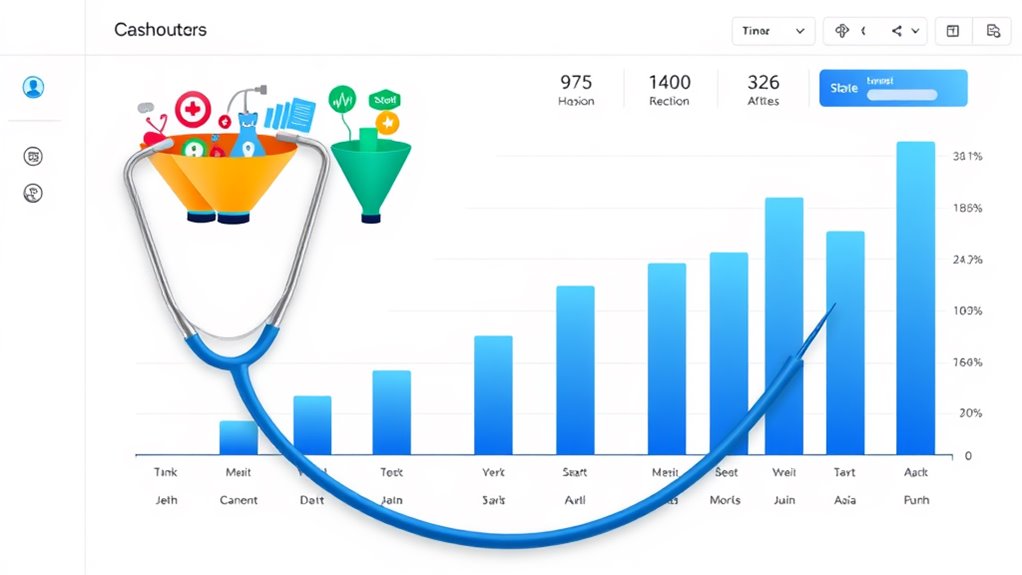
While journal partnerships establish authority, tracking how effectively your website converts visitors into patients determines your SEO success. With industry benchmarks showing a median conversion rate of 3.6%, you’ll need robust conversion strategies to stand out in the healthcare sector. Understanding your patient engagement metrics helps you refine your approach and improve your results.
Integrating Google Ads and Analytics provides comprehensive tracking capabilities for better insights. To effectively track patient conversion rates, focus on these essential elements:
- Implement thorough analytics tools like Google Analytics to monitor visitor behavior and conversion paths.
- Create patient-centric content that addresses specific healthcare concerns and questions, as local content marketing can significantly improve engagement and visibility.
- Optimize your local SEO presence to capture high-intent prospective patients.
Your conversion rate calculation is straightforward: divide your total conversions by website visitors and multiply by 100. By tracking this metric consistently, you’ll gain valuable insights into your marketing effectiveness.
The data you collect will help you enhance patient communication and refine your SEO strategies for better results. Remember to regularly analyze your conversion metrics and adjust your approach based on the findings, as continuous optimization is key to maintaining strong conversion rates in healthcare marketing.
Success Breeds Medical Growth
Implementing strategic healthcare SEO delivers measurable growth for medical practices through increased visibility, patient engagement, and practice authority. A thorough approach combining local SEO optimization, expert content creation, and technical excellence positions healthcare providers at the forefront of patient searches. Fresh content updates signal ongoing relevance to search engines and boost rankings.
When medical practices leverage targeted keywords, mobile-optimized websites, and authoritative content meeting YMYL standards, they experience:
- Higher search rankings for relevant medical terms
- Increased local visibility and patient inquiries
- Enhanced credibility through expert-reviewed content
- Improved patient engagement across multiple platforms
- Better conversion rates from search to scheduled appointments
Take the next step in growing your medical practice. Contact Team Soda’s healthcare SEO specialists to develop a customized strategy aligned with your specific services and patient needs.
Our proven approach delivers measurable results while maintaining strict HIPAA compliance and medical industry standards.
Conclusion
By implementing these tailored SEO strategies, you’ll enhance your healthcare facility’s digital presence while maintaining patient confidentiality. You’re now equipped to optimize medical content, leverage directory listings, and track patient acquisition metrics effectively. Remember, success in medical SEO isn’t an overnight miracle – it’s a carefully planned journey that requires ongoing attention to detail and adherence to industry guidelines. Your practice’s digital growth awaits with these specialized techniques.