


AI Marketing Starts With One Useful Workflow
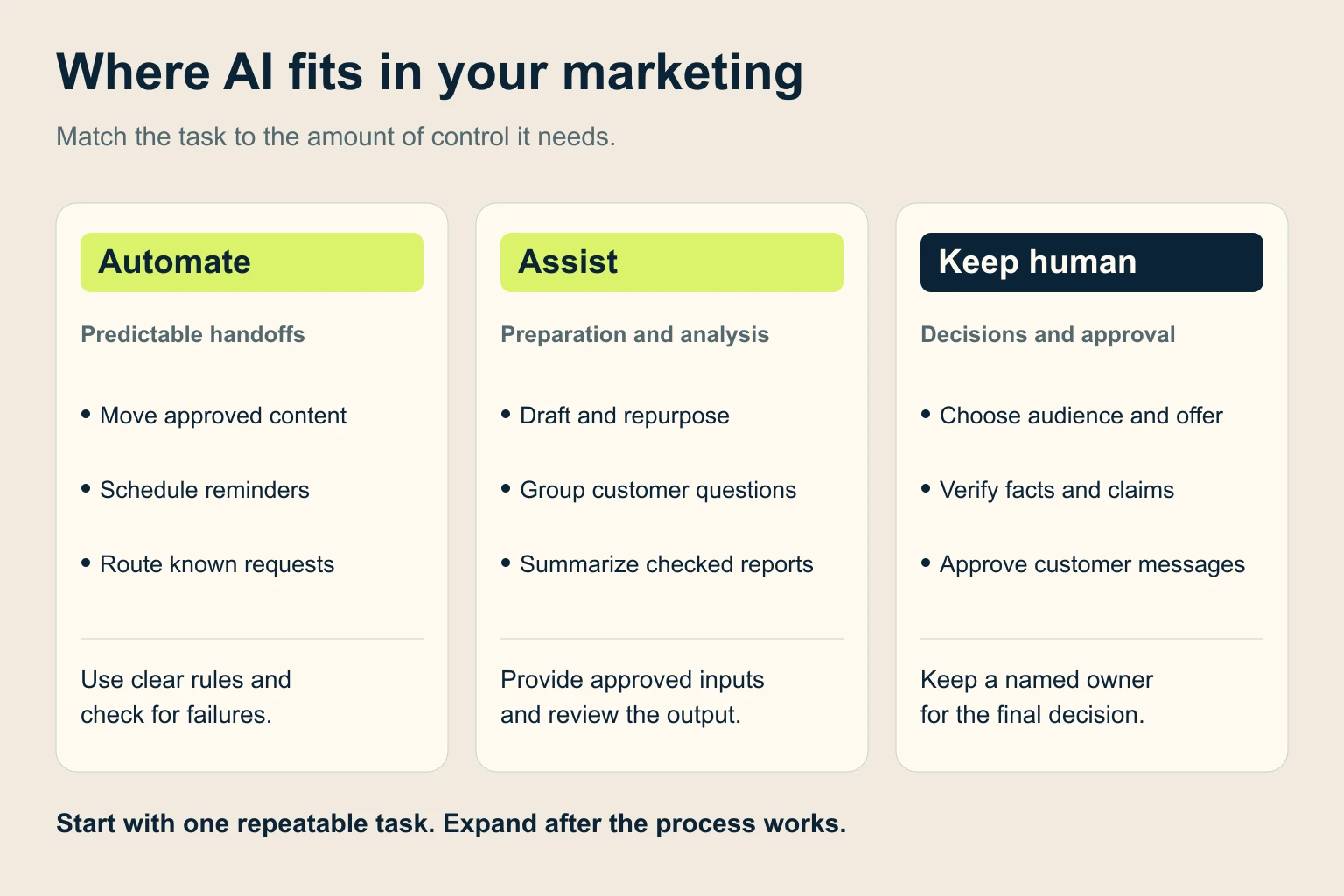
Start by using AI to prepare a repeatable marketing task that already has reliable inputs and a clear reviewer: drafting an email from an approved offer, repurposing an expert article, or organizing a report. Automate the predictable handoffs once the process works. Keep your audience, promises, factual checks and final approval with a person.
AI marketing for small business works best when it addresses a real bottleneck. Perhaps a specialist never has time to write, every newsletter starts from a blank page, or the monthly report arrives without a decision. The task, source material and owner need to be clear. Buying another subscription before identifying the problem often adds more work.
Keep a named reviewer between the draft and the customer.
What Is AI Marketing for a Small Business?
AI marketing uses artificial intelligence to support activities such as research, content creation, campaign preparation, customer communication and analysis. Generative AI can produce draft text or images; other AI features classify information, find patterns or recommend an action. The business still decides what to offer, whom to serve and which result matters.
AI and automation also do different jobs. AI can suggest a draft or interpret messy information. A conventional automation tool can move an approved file, create a task or send a scheduled reminder using rules. You may need both, or a simple template may solve the problem without either.
The U.S. Small Business Administration identifies practical uses including reusable templates, content preparation and organizing business information. Start with a bounded task you can check, then decide whether expanding it would help your marketing efforts.
Which AI Marketing Tasks Are Worth Automating First?
Choose work that repeats, uses information you can verify and has an output someone can judge quickly. A small team can often make progress with content preparation or reporting before connecting several systems. If nobody agrees what a good result looks like, define that first.
| Marketing task | Useful starting point | Human responsibility |
|---|---|---|
| Repurpose approved content | Draft an email and social posts from a current article or service brief | Check meaning, claims, tone and the next step |
| Prepare email marketing | Draft subject lines and a message from an approved offer | Confirm audience, terms, links and send approval |
| Organize customer questions | Group an approved, anonymized question list into themes | Decide which questions matter and verify the answers |
| Prepare a marketing report | Summarize a checked export and flag changes to investigate | Validate figures, explain context and choose the action |
| Handle content handoffs | Create review tasks and schedule approved material | Own exceptions and check that the handoff completed |
| Reply to a complex inquiry | Suggest a response using an approved answer library | Check the customer’s circumstances and send the reply |
A small business owner should also consider how expensive a mistake would be. Drafting a private outline is easier to reverse than sending a customer an incorrect price. Start with assistance, observe the results and increase automation only for the steps that have become dependable.
Examples of AI Marketing: Content, Email and Reporting
Content marketing: make existing expertise easier to reuse
A professional-services firm can use AI to turn approved expert notes into a service-page outline. A retailer can turn a verified product guide into a newsletter. A moving company can organize its existing preparation advice into a customer checklist. These examples of AI marketing share an opportunity: useful knowledge already exists, but preparing it for another channel takes time.
Keep the original source attached to the draft. AI writing should preserve the facts and limitations rather than invent credentials, testimonials, product features or results. Publishing more AI content is only useful when customers receive information worth reading. Google’s guidance on generative AI content emphasizes accuracy, manual review and added value; producing many pages without useful value can violate its spam policies.
Email and social media marketing: prepare before you schedule
For email marketing campaigns, give the tool the actual offer, audience, deadline if applicable and destination page. Ask for a draft with a single next action. Review those facts before using the platform’s scheduling or sending features. Faster preparation does not make an unsuitable audience or weak offer effective.
For social posts, adapt the approved idea to the channel instead of publishing the same text everywhere. Check links, image rights, dates and tone. An AI image generator or AI video tool can support creative preparation, but generated visuals should not be presented as photographs or footage of work your company actually completed.
Reporting: turn marketing data into questions to investigate
Ask AI to summarize a checked report, identify unusual changes and list the evidence needed to explain them. For example, fewer form submissions might reflect a tracking fault, a change in visitors or a broken form. A confident explanation is a hypothesis until someone checks it.
Keep the original figures available. Verify calculations against the reporting system and separate observations from interpretations. AI analyzes the material you provide; it does not automatically know which inquiries became suitable customers or what changed inside your business.
How Do You Build a Dependable AI Marketing Workflow?
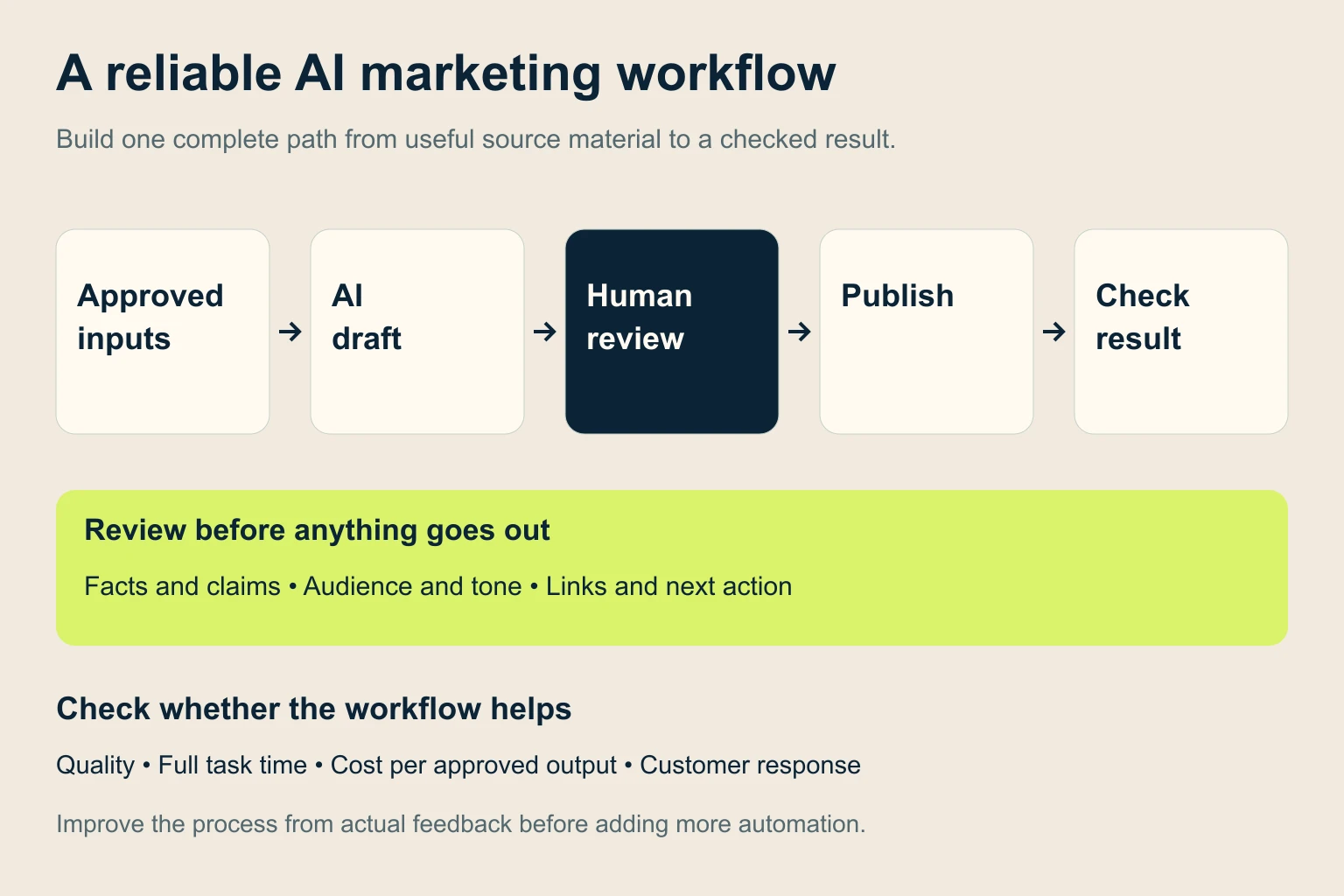
Write down the current process before choosing software. Name its input, output, owner, reviewer and success measure. Then test one complete path from source material to a usable result. The following content workflow gives you a practical starting point without requiring technical development.
1. Choose one customer question and one output
Pick a question that appears in real sales or support conversations. For a service business, that could be what is included before a consultation. Decide whether the immediate output should be a website section, an email or a short sales resource. Creating all three at once makes the first test harder to assess.
2. Assemble the approved source material
Give the reviewer a current service description, confirmed scope, relevant examples and the exact next step. Remove information the task does not need. Use tools and account settings approved for the information involved; customer names or confidential records are rarely necessary to draft a general marketing explanation.
Include a short brand note: how you describe the service, words you avoid and one example of good writing. A generative AI tool cannot reliably infer your current policies or voice from a vague instruction to sound professional.
3. Use a brief that makes missing information visible
Try this reusable instruction with the approved information attached:
Draft an email for the audience described below using only the approved source material. Answer the stated customer question, explain the relevant service and end with the supplied next step. Keep our tone clear and specific. Do not invent prices, qualifications, availability, testimonials or results. Put unanswered questions in a separate review list.
The review list matters as much as the draft. If an answer needs a price or condition that the source does not contain, obtain it from the owner of that information. Do not ask the tool to make the missing fact sound plausible.
4. Review the work against a short acceptance check
The reviewer checks factual accuracy, completeness, brand voice and the action being requested. Open every link. Confirm that the message fits the audience and that the page it links to answers the next question. Keep a record of corrections so recurring problems can be fixed in the source or brief.
NIST’s Generative AI Profile describes the risk of confidently stated false content. A polished paragraph therefore needs factual review just as a rough one does. The check should be proportionate to the material and its consequences.
5. Publish through your existing process and compare results
Once approved, move the work into the normal email, website or social publishing process. Record how long preparation and review took, how much rework was needed and what customers did next. Connect the handoffs only after the workflow works repeatedly. Marketing automation should preserve the approval step rather than quietly bypass it.
How Can AI Help Without Replacing Human Judgment?
Keep responsibility for positioning, the offer, customer understanding and final judgment with your marketing team. AI can help generate options, but selecting marketing strategies still requires knowing your capacity, margins, customers and priorities. More variations cannot resolve an unclear business decision.
Use human review for public promises, sensitive customer replies and changes to campaign spending. AI chatbots need an accurate answer source and a clear handoff when a question falls outside their scope. An AI agent with permission to take actions needs tighter boundaries than a writing tool that only produces a draft.
Decide who handles exceptions before connecting the process. If a tool uses an outdated offer, a delivery fails or a reviewer is unavailable, the workflow needs a named owner and a pause or manual route. This is ordinary operating discipline: someone remains accountable for the customer experience.
How Do You Choose AI Tools for Small Business Marketing?
The best AI marketing tools for your business are the ones that fit a defined job and a process your team can maintain. Check the AI features already available in your existing software before adding another platform. A free version can help you test a task, but examine its limits, information settings, export options and total costs before using it routinely.
| Tool category | Use it for | Check before adopting it |
|---|---|---|
| AI writing and research assistant | Outlines, draft copy and organization of approved information | Source handling, factual review and useful exports |
| Email or customer relationship platform | Draft preparation, audience organization and approved follow-up | Existing permissions, review steps and contact settings |
| Design and media tools | Draft layouts, image variations, captions and repurposing | Editing control, usage rights and accurate representation |
| Workflow automation tool | Moving approved information between systems | Supported connections, failure notices and task limits |
| Reporting assistant | Summaries and questions from checked marketing data | Traceable figures, calculations and a human decision-maker |
Test candidate tools on the same representative task. Compare the finished output after editing, not the first response. A tool like a general writing assistant may be sufficient for drafts; a connected workflow may need permissions, monitoring and support that a basic subscription does not provide.
Before using AI tools routinely, check whether you can correct the output, keep the approved version and export your work. For a small business, a useful test is whether a colleague can run the process from its instructions. AI capabilities that only one person understands can make everyday marketing workflows harder to maintain.
You do not need separate AI software for every channel. Software marketed as powered by AI should still pass the same test: does it improve the work enough to justify the cost and attention? Choose fewer tools that help your team finish useful work.
How Much Does AI Marketing Cost, and Is It Helping?
Budget for three things: software, setup and ongoing operation. Software may charge by user, contact count, tasks or usage. Setup includes preparing source material, documenting the process and connecting systems. Ongoing work includes review, corrections, maintenance and checking whether the output still serves the customer.
A low subscription price does not establish the cost of a working process. Ask a provider to separate license costs, implementation, training and recurring support. Clarify who owns the accounts, templates and documentation. Your marketing budget should reflect the complete workflow rather than the advertised entry price.
Use a few comparable tasks to establish a baseline. Record preparation time, review time, corrections and accepted outputs. Then compare the AI-assisted process on similar work. Useful measures include:
- Cost per approved output: attributable software and service costs plus staff time, divided by accepted outputs.
- Time per finished task: include review and rework, not only drafting time.
- Quality: factual errors, missed requirements and the amount of editing needed.
- Customer response: relevant replies, qualified inquiries, bookings or purchases that you can observe.
Use a consistent method for valuing staff time and allocating shared costs. Treat saved capacity separately from actual cash savings. Completing more drafts does not prove increased revenue, and a short test rarely establishes how much new business a workflow caused. Connect your content marketing with lead measurement and sales feedback when assessing the wider result.
Is AI Marketing the Same as AI SEO, AEO or GEO?
These services can overlap, but they solve different problems. AI marketing can improve how your team prepares and operates marketing work. AI SEO, answer engine optimization (AEO) and generative engine optimization (GEO) concern how customers find and understand your business through search and AI answers.
Buying a content tool does not automatically make your company appear in an AI recommendation. If visibility is the problem, review the information, pages and sources customers encounter. TeamSoda’s AI SEO services and search-priority guide explain that connected work. If production is the bottleneck, start with the workflow instead.
When Should You Hire an AI Marketing Agency?
Professional help becomes useful when the obstacle is designing, connecting or maintaining the process. A single draft with a capable reviewer may be manageable internally. Several systems, inconsistent source material, repeated errors or unclear ownership can justify a focused engagement.
Look for a partner who can help businesses turn a recurring problem into a working process. Ask for:
- A clear first task: the bottleneck, users, inputs, output and expected improvement.
- A working pilot: something your team can review on representative work before expanding it.
- Defined responsibilities: who checks facts, approves publication, manages tools and handles exceptions.
- Practical handover: documentation, reusable templates, account access and team guidance.
- An evaluation method: quality, time, costs and the customer result being assessed.
Do not judge the proposal only by the number of tools or prompts included. Ask whether the partner will implement the process, train your team and revise it after feedback. Compare a one-time setup with ongoing support based on the work you actually need.
TeamSoda’s AI marketing service covers workflow planning, search and content support, customer-facing resources, working pilots and measurement. The useful starting point is a specific task and an agreed result—not an assumption that every business needs the same automation.
Your First-Month AI Marketing Plan
- Week one: choose and measure. Select one recurring task, gather approved inputs, assign an owner and record how the current process performs.
- Week two: build and review. Test a brief or workflow, review the output and document corrections.
- Week three: repeat on comparable work. Check whether the process remains useful beyond its first successful example. Keep human approval in place.
- Week four: keep, improve or stop. Compare quality, full task time, cost and customer feedback. Expand only the steps that justify it.
If you want help choosing and implementing that first workflow, discuss your AI marketing needs with TeamSoda. Tell us which task takes too long, who handles it now, which tools you use and what a better result would mean for your business.