


What Should a Business Fix First for Google AI Overviews?
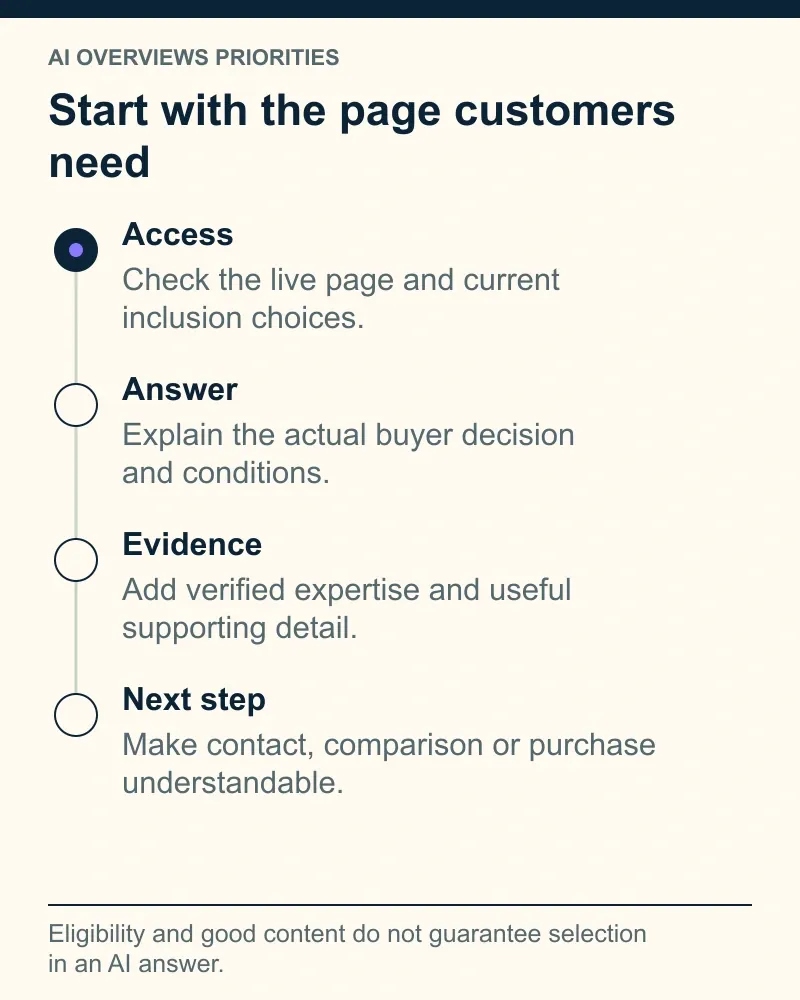
Before you pay someone to optimize for AI Overviews, pick a buying question whose answer matters. If a customer asks whether installation requires a shutdown, open the page you want Google Search to find. Can a buyer see the conditions, who assesses the site and how to request that assessment? Then check the page’s indexing status in Google Search Console.
If an AI Overview appears, save the question and any source it links. Read the source alongside your page. A wrong detail about shutdowns is worth correcting for buyers whether or not Google shows an overview on the next search.
If the page itself is missing from ordinary Google results, start with the search visibility diagnosis before commissioning AI work.
How Do Google AI Overviews Work Within the Search Journey?
AI Overviews are generated summaries within Google Search that can include supporting links. They do not appear for every question. A person may read the summary, compare linked sources, search again or visit a business directly. Your website needs to support the research and the decision that follows.
For a buyer comparing accounting support, the useful question may be whether they need ongoing bookkeeping, year-end preparation or both. A page that explains those boundaries can help them qualify the service. A generic paragraph saying the firm offers outstanding solutions gives the buyer little to check.
Keep the terms clear. Traditional SEO concerns the website’s discovery and search performance. Generative engine optimization and answer engine optimization are commonly used service labels. On a proposal, ask which actual pages, business facts, sources and customer journeys the work will improve. AI systems influence research, while the website still needs to serve people arriving from traditional search and other channels.
Google Search Central recommends the same foundational SEO best practices for AI Overviews that apply elsewhere in Search. For the installation page, that means first checking whether Google can index it and whether a buyer can verify the shutdown conditions. Ask what specific problem any proposed markup would solve.
Can the page appear in Google Search before you optimize for AI Overviews?
Ask the technical team to review the actual page, not just a domain score. A compelling article cannot help if the intended page redirects incorrectly, is blocked by hosting controls or presents an empty experience to the relevant crawler.
The review should cover:
- Page availability: the correct live URL opens reliably and presents its main information.
- Search settings: crawling, indexing, canonical and preview choices match the owner’s intentions.
- Internal discovery: useful pages are reachable from appropriate service, category or resource pages.
- Mobile use: the main answer is readable and the inquiry or purchase action works.
- Business information: service, location, product and contact details agree with the business’s actual offer.
Include a current platform-specific check: Google documents a Search generative AI control in Search Console. Review the effective setting and any inherited parent-property choice. An intentional exclusion should be discussed with the property owner; do not silently change it as part of an optimization checklist.
These checks establish whether a page can participate. Eligibility does not mean Google will select it. Keep a record of the checked URL, date, evidence and person responsible for any fix.
An indexed page can appear in Google Search and still be absent from a particular AI Overview. To optimize your content, start with a missing fact a buyer can use. For an installation page, ask the technician what determines the shutdown time. Content that answers that question helps buyers whether or not you appear in AI Overviews.
Which Buyer Questions Should You Optimize Content Around?
Choose questions from real commercial conversations. Ask sales and service staff where prospects hesitate, misunderstand the offer or need help comparing options. Combine that knowledge with relevant search-query data and a review of the existing website.
Good starting points include suitability, scope, conditions, alternatives and process. For a training business, that might mean whether a course suits a new supervisor, which prerequisites apply and how an employer books a group. For a retailer, it might mean fit, material differences, compatibility or delivery restrictions.
Group related questions around the buying task. You do not need a separate article for every phrasing. If a question belongs on an existing service or product page, improve that page. Create new content only when it has a distinct purpose and a useful contribution.
When deciding how to optimize for AI Overviews, start with the same question you would ask in search engine optimization: which page should satisfy this person’s need? Optimizing for AI should sharpen that decision. It should not turn a useful page into disconnected fragments written only to resemble snippets. For discovery beyond Google, see the AI search guide.
A practical question-selection worksheet
| Record | Example of a useful entry |
|---|---|
| Customer and decision | Office manager choosing an on-site training course |
| Unanswered question | Can staff with different experience levels join the same session? |
| Best page owner | The relevant group-training service page |
| Evidence needed | Trainer-approved prerequisites, formats and limitations |
| Customer next step | Send group size, experience mix and preferred dates |
| Review owner | Service lead checks accuracy before publication |
Adapt the entries to your own offer. It is often more useful to complete one worksheet properly than to commission a long list of broad AI-generated summaries.
How Should You Optimize Content for AI Overviews and Human Decisions?
Give the reader something they can use to make the decision. A direct answer helps, but the detail behind it matters: important conditions, original examples, first-party expertise and a clear explanation of how the service works.
Consider a generic answer such as “Our consulting services suit businesses of all sizes.” It hides the useful qualification. A stronger explanation states the business stage, systems or internal capacity the engagement requires, then explains the alternatives when those conditions are absent. Your delivery team should approve those boundaries.
Useful supporting material can include an annotated process, a comparison built from your actual offer, a specification, a permission-cleared project explanation or a reproducible demonstration. Do not invent a case study or attach unrelated research to a sales claim.
Can headings, tables and short answers help?
Use them when they make the information easier for people to follow. A comparison table is useful when the reader needs to compare equivalent criteria. A question-led heading is useful when it identifies the next decision. Neither creates a guaranteed place in an AI-generated summary.
Write the short answer with its important qualification attached. “Available nationwide” may need a product, licensing, shipping or delivery exception. Separating that condition into distant fine print can mislead the reader and make an extracted answer less useful.
Avoid repetitive FAQ sections that merely repeat the article. Put questions where they belong in the main content. Add original photography, diagrams or video when they clarify the product or process; visual decoration cannot compensate for an incomplete explanation.
What Would an AI Overview Optimization Brief Look Like?
Take a business selling specialist commercial equipment. Buyers repeatedly ask whether a product works with an existing setup. The current page lists benefits but omits the compatibility conditions.
A useful brief would identify the exact product page, ask the product specialist for supported and unsupported configurations, add a clear comparison, and route uncertain customers to a suitable pre-purchase question. The developer checks the page and contact action. The marketing team records the release and reviews relevant searches and inquiries afterward. Use the content brief template to capture the product question, verified facts and the person who approves the answer.
The work has value even if an AI Overview never cites the page: customers can establish fit and avoid an unsuitable order. If relevant AI answers later link to it, that is an observed outcome to record, with its question and date. It should not be retroactively presented as proof that one heading caused the citation.
That separation keeps SEO and AI visibility work accountable. It also helps decide whether the next investment belongs in product detail, expert content, technical access, outside references or the customer journey.
How Should You Measure Visibility in Google AI Overviews?
Use platform reporting alongside dated observations and business records. Google’s Generative AI performance report covers impressions from supported Search AI features, including AI Overviews and AI Mode. Check its current scope and limitations; it is not a complete cross-platform lead report.
For manual observations, record the question, market, date, experience and linked URL. Keep the check method consistent enough to compare. A screenshot is evidence of one returned answer, not a stable ranking for every customer.
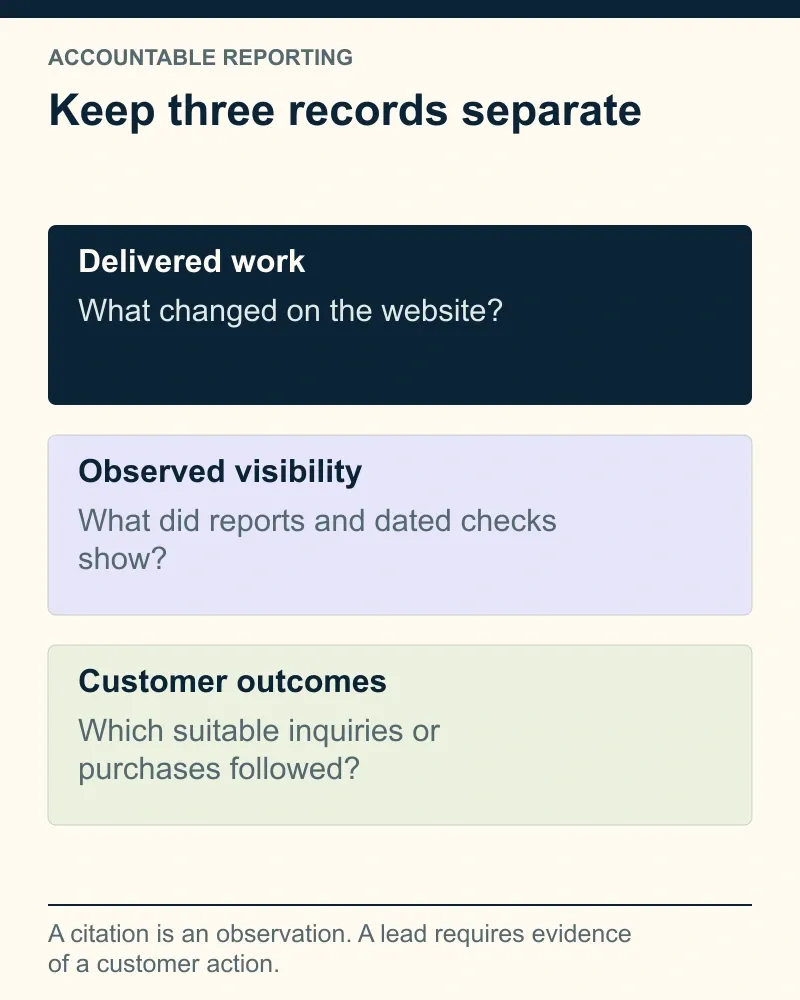
Review three different kinds of evidence:
- Work delivered: which access, content, business-information or journey changes were released?
- Visibility observed: what do the available platform reports and repeated sample checks actually show?
- Commercial outcomes: did relevant inquiries, bookings, purchases or qualified opportunities change?
Record changes to tracking, promotions and the wider business. A rise in search impressions is not itself a rise in clients. Analytics referrals and customer-reported discovery can add context, but some journeys will remain unattributed. Use the guide to measuring calls, forms and leads to check what happened after a visit.
Keep an ordinary SEO baseline alongside the AI review. Organic search visits, relevant Google search results and landing-page outcomes provide context for the same business questions. Our SEO reporting process shows how to review those signals alongside qualified inquiries. Search ranking and AI Overview citations describe different observations; neither should be presented as the other. Your SEO strategies should preserve that distinction in the reporting.
Do not optimize a visibility score without understanding its denominator. Ask which questions, platforms and dates it covers, whether branded questions are separated, and how missing answers are treated. A bigger score can come from a different sample rather than better customer discovery.
What does an AI Overview citation actually prove?
Being cited in AI Overviews proves that a page was linked in the observed answer. It does not establish why it was selected, whether every reader saw it or whether the business won a customer. Being featured in AI Overviews is therefore one piece of evidence within a wider SEO review.
Separate Google Search Console data from checks performed by AI tools. The former describes its reported population and reporting scope; the latter describes the sample the tool ran. Neither should be relabelled as a complete view of how every AI model or search engine represents the business.
What Should the First SEO and AI Optimization Cycle Deliver?
Choose one service or product group and a small set of decision questions. Before the work begins, save the current pages, their search performance and the questions your customer-facing team hears. Record the intended improvement in plain language, such as helping prospects distinguish a basic service from a specialist engagement.
Next, complete the dependencies. Technical SEO may need to restore access before content changes can be assessed. A product specialist may need to approve a compatibility table. A form may need to route to a different team. Put those dependencies into the plan so the content deadline does not hide missing implementation.
After release, verify the changed page and its customer action. Keep the release date and review the available visibility data over appropriate periods. If AI summaries still misdescribe the offer, inspect the returned sources and the published wording before commissioning more pages. If relevant visits arrive but inquiries remain unsuitable, review qualification and scope before pursuing more visibility in AI answers.
| Decision at review | Evidence that helps | Possible next action |
|---|---|---|
| Can the right page participate? | Access checks, indexing evidence and current inclusion settings | Resolve a specific technical or settings issue with its owner |
| Does the answer explain the offer accurately? | Dated answer examples and their actual supporting pages | Clarify the relevant facts or investigate an inaccurate outside source |
| Is the page useful after arrival? | Mobile journey checks and recurring prospect questions | Improve the explanation, evidence or inquiry process |
| Is the work helping the business? | Qualified inquiries and sales feedback alongside visibility | Continue, revise or redirect the next cycle |
This process supports organic search and Google AI Overviews specifically without assuming every search result needs a new optimization tactic. The next cycle follows the remaining customer problem. It should not automatically repeat the first deliverable or expand the keyword list because a reporting month has ended.
What Should You Get From Professional AI Overviews Optimization?
A useful proposal names the priority customer questions, affected pages, evidence requirements, implementation owners and reporting limits. It should explain what happens after the initial audit. Paying for a report and paying for the changes are different scopes.
Give the provider the installation question. Ask them to identify the missing fact, name the person who can verify it and show where it belongs on the page. Ask how they would verify the repair in traditional search and in any AI-generated summaries they actually observe. A promise to put your business at the top of search results gives the buyer no way to check the work.
- Which work supports conventional search as well as AI answers?
- Who checks technical access and current Google settings?
- Who supplies and approves the factual expertise?
- Which pages will be changed, and who publishes them?
- What will reporting distinguish between work, visibility and qualified outcomes?
- Which results are outside the agency’s control?
If you need help investigating an inaccurate answer, ask about TeamSoda’s AI SEO services. Bring the question, the answer you saw and the source your team can correct.
Use the agency evaluation guide when comparing who will verify the business facts, publish the correction and test it again.