



Help the Right Customers Find Accurate Information About Your Business
Ask ChatGPT a question a customer might ask before choosing you. For a commercial printer, try asking who can produce a short run of menus in the city you serve. Save the wording, date, answer and any cited pages. An incorrect service claim gives you something specific to investigate, even when a mention alone tells you little.
Run a second question without the company name. “Does Acme print menus?” tests whether the answer describes a known firm. “Who prints short runs of menus in my city?” tests whether the firm appears when the buyer has yet to choose.
Make the next step useful for the customer who discovers your business.
How Do You Check Whether ChatGPT Mentions Your Business?
Use a small, repeatable set of real buying questions before you change anything. Include the service, location or constraint that makes a customer suitable. Keep branded checks separate from discovery questions so you can tell recognition apart from new-customer reach.
For example, a buyer might ask for an accountant who supports multi-state payroll, a bicycle shop that repairs commuter e-bikes or a consultant who can implement a specific software migration. These are useful starting points because they describe a need. “Tell me why our company is the best” gives you little evidence about discovery.
- Choose five to ten questions. Draw them from sales calls, customer emails and keyword research. Include a comparison, a suitability question and a location question where relevant.
- Use ChatGPT with web search when available. Record whether search was used. An answer without a current source is a different observation from a search-supported response.
- Save the conditions. Record the exact prompt, date, stated location, search setting and whether prior conversation supplied information about your company.
- Record what appeared. Note the business names, linked sources, factual mistakes and relevant omissions. Save the answer or screenshot for a later comparison.
Repeat selected questions in fresh conversations and review them over time. Treat the results as a sample of AI answers, not a universal ranking report. Different prompts and conversation context can produce different observations; one favorable answer cannot establish market-wide visibility.
What should a useful baseline include?
A simple worksheet can hold the query, customer need, company mention, citation URL, fact accuracy, landing page and next action. Use our guide to how AI search chooses sources when you interpret the citation column. Keep the full denominator: if your business appears in three of ten sampled answers, report three of ten rather than “300% growth” from a tiny starting point. Separate the original sample from new questions added later.
Also note whether the answer actually matches the service you want to sell. Getting your brand mentioned for work you no longer provide creates the wrong expectation.
Why Doesn’t Your Business Show Up in ChatGPT—and What Should You Fix First?
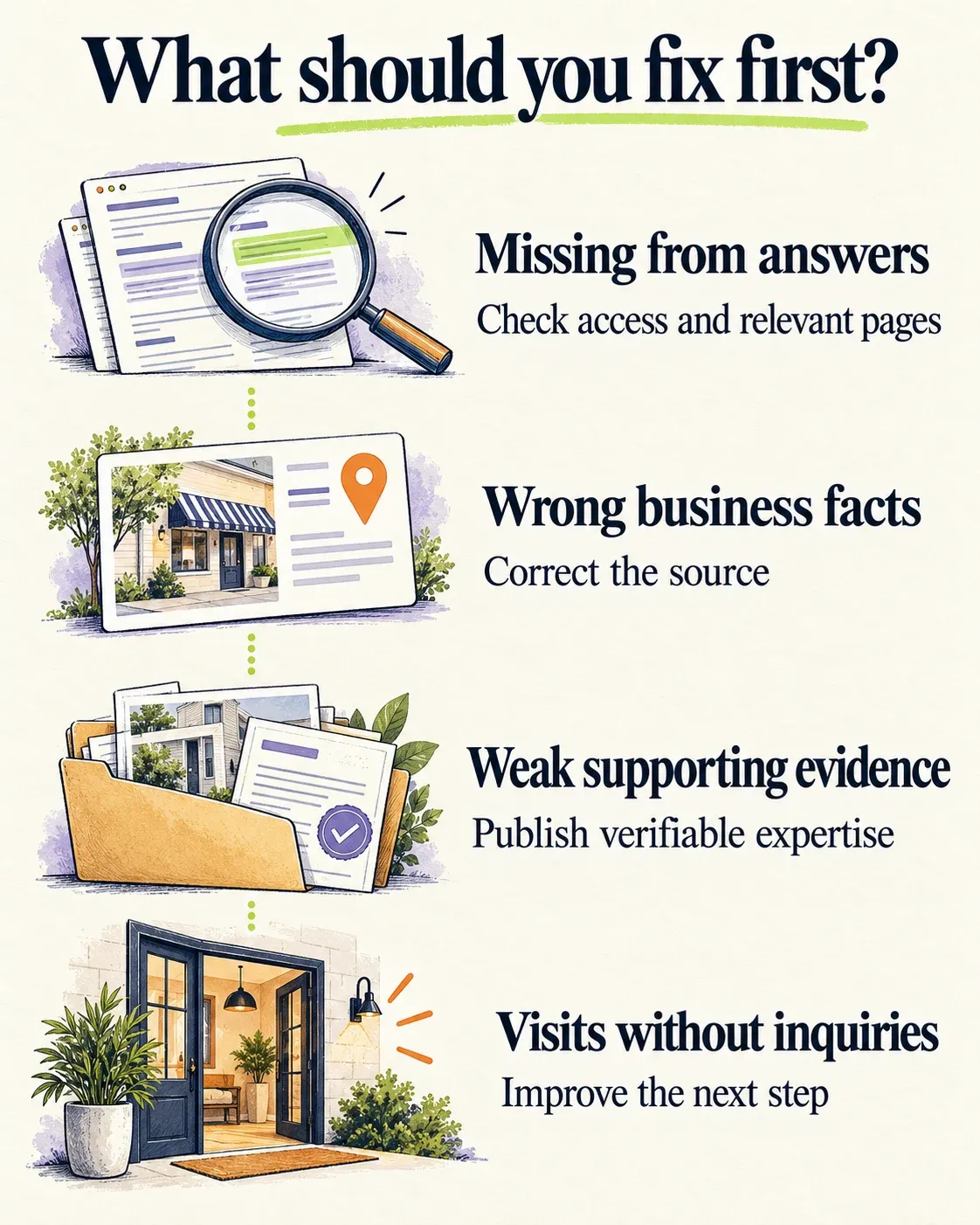
Use the saved answer to pick the next check. A wrong address gives you a source to investigate. A missing mention on its own tells you too little to diagnose a crawl problem.
| What you observe | What to inspect | First useful action |
|---|---|---|
| Your business is missing from relevant answers | Website access, relevant service pages and the sources that do appear | Resolve a confirmed access issue or improve the page that should answer the question |
| Your company is named with wrong facts | The cited page and your current public business information | Correct the original source you control; request a correction from other publishers |
| Competitors have stronger supporting evidence | Relevant examples, credentials, comparisons and independent coverage | Publish substantiated expertise and pursue appropriate editorial opportunities |
| Visitors arrive but suitable inquiries do not | Landing-page fit, proof, contact options and lead handling | Clarify the offer and test the inquiry journey |
If the answer cites an old menu, “replace the discontinued items on the cited page” gives the printer a job they can check. “Make AI recommend us” gives the team no way to identify or verify a fix.
Can ChatGPT Search Access Your Website?
OpenAI documents separate controls for search discovery and model training. Ask your developer to review the current OpenAI crawler documentation before changing access rules:
- OAI-SearchBot is used for surfacing sites in ChatGPT Search. Opting out prevents inclusion in search answers, although navigational links can still appear.
- GPTBot concerns content that may be used for model training. Its control is independent of OAI-SearchBot.
- ChatGPT-User handles certain user-triggered visits. It does not determine ChatGPT Search eligibility.
Allowing access creates an opportunity to be found; it does not guarantee a citation or recommendation. You can permit search discovery while making a separate decision about training data.
A technical SEO review should check the public page, robots.txt and any confirmed hosting or firewall block. Verify legitimate crawler traffic against OpenAI’s published crawler IP ranges. Fix a specific blocking rule where appropriate while retaining protection for account pages, private records and abusive requests.
Then check the customer-facing basics: does the important page load, can a visitor read the main explanation and do internal links lead to it? Put essential facts in readable text rather than only inside an image. An attractive page is less useful if its service description cannot be easily found.
What Content Helps Customers Understand Why Your Business Fits?
Improve the page closest to a real buying decision first. For many companies that is a service page, product page or location page. Write content that answers the questions your team already handles before a sale.
- Fit: who the service is for, the problems it addresses and situations where another option is more appropriate.
- Scope: what is included, what is separate, relevant service areas and practical requirements.
- Decision details: the process, timing factors, pricing approach and what a customer needs to prepare.
- Evidence: named expertise, current credentials, original examples and project details you have permission to share.
- Next step: a useful consultation, estimate, booking or purchase path with clear expectations.
Specific detail gives people something they can evaluate. A professional-services firm can explain who owns implementation after an audit. A retailer can publish compatibility and repair limitations. A local business can state its actual service area and appointment requirements. None needs to claim expertise in every topic to build a credible online presence.
How do you create authoritative content without publishing filler?
Choose one customer question and involve someone who does the work. Explain the answer directly, add the important exceptions and show the supporting evidence. A well-structured comparison of two service options can be more useful than ten broad articles generated by AI.
Use clear headings, descriptive page titles and internal links to the appropriate service. Add an author or reviewer where their expertise matters. Identify the date and scope of original data. Customer results should explain what was measured and over which period, with permission and limits stated.
High-quality content earns its place by helping a decision. Repeating “best provider” or adding a long FAQ to every page does not supply proof.
Do structured data and schema markup solve ChatGPT visibility?
Use structured data to describe real page information accurately. The Schema.org getting-started guide explains how markup describes the information on a page. Measure ChatGPT mentions separately to see what appears for the questions you tested.
Check that organization details, products or other relevant markup match what visitors can see. Treat schema markup as a supporting website task. A correct label cannot replace a missing explanation, and a purchased “AI schema” package should still have a defined, reviewable purpose.
Which Business Listings and Outside Sources Should You Improve?
Open the sources linked in the answers you sampled. Inspect the actual page before deciding where to invest. Is it a trade association, independent review, supplier page, publication or business listing? Does it contain accurate information about your company and the service in question?
Start with corrections: your business name, website, contact details, service scope, location and current credentials. Keep the same real-world identity across the web. Update business listings you manage and request corrections to outdated profiles you do not control.
Next, pursue coverage that would be useful even without an AI mention: an expert contribution to a relevant publication, a legitimate association profile or a detailed customer account. Ask for honest reviews through a consistent process. Never invent testimonials or present paid placements as independent endorsements.
Forums like Reddit and Quora may help you understand how buyers describe a problem. Participate only where your expertise is useful and disclose your relationship. Flooding discussions with promotional answers creates little trustworthy evidence. The same standard applies to social posts and directory submissions: relevance comes before volume.
If a competitor appears, open the source named in the answer. Check whether it verifies a service detail missing from your own page before commissioning new content.
Should You Optimize for Other AI Tools and Traditional SEO Too?
Keep SEO and AI visibility connected. Traditional SEO helps people discover and understand your pages through a search engine. Answer engine optimization, or AEO, focuses work around useful answers; generative engine optimization, or GEO, addresses how your organization is represented in generated responses. The labels overlap, so judge a proposal by its deliverables.
For Google’s AI Overviews and AI Mode, Google says its established SEO practices still apply. It does not require special AI markup or a new AI text file. This is guidance for Google’s search features; do not assume it describes the rules of every AI system.
When customers use AI tools like ChatGPT, Perplexity, Gemini or Claude, test relevant questions in the tools they actually use. Record each platform separately. Success in one sample does not establish visibility across all AI assistants or Google search results.
Our SEO, GEO and AEO decision guide can help you prioritize the overlapping work. A small team usually benefits from improving shared facts, useful pages and measurement before buying separate campaigns for every acronym.
How Do You Measure ChatGPT Results Beyond Mentions?
Track four outcomes separately: a mention, a citation, a visit and a qualified inquiry. A source link may point to another publisher. A visitor may be researching rather than ready to buy. Neither observation should be reported as a new customer.
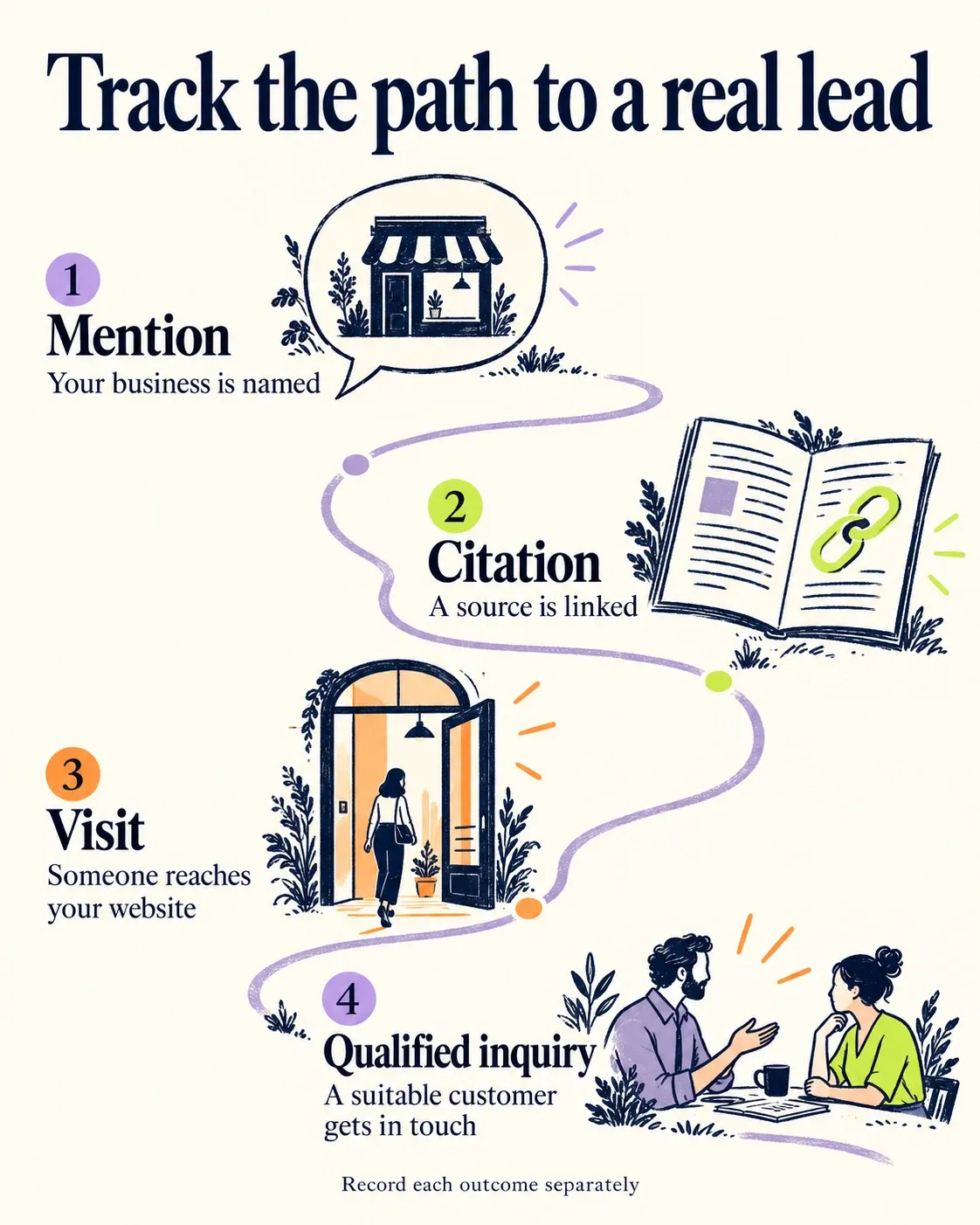
Review referral information in your website analytics where it is available. Check which landing pages receive those visits and whether people complete meaningful actions. Apply your existing privacy and consent requirements when configuring measurement. Do not assume analytics captures every AI-assisted journey: someone may return through another channel or contact you directly.
Add a simple “How did you hear about us?” question to your sales process where appropriate. Keep self-reported discovery alongside tracked referrals rather than silently combining them. A prospect who reports using ChatGPT and later submits a form is one lead, not two.
Define “qualified” before reporting it. For a service firm, that might mean the right service, geography, budget and buying timeframe. Connect inquiries with booked calls and won work where reliable records exist. Our guide to measuring calls, forms and leads covers that customer journey.
How long does it take to appear in ChatGPT?
Set checkpoints for completed work and repeat observations, rather than promising a date for inclusion. Correcting a page, having it discovered and seeing it used in an answer are separate events. Record when the change went live and recheck the original questions on an agreed cadence. Report uncertainty when the sample is small.
When Is It Worth Getting Help with AI Visibility?
Specialist support is useful when the problem crosses several responsibilities: access rules, service-page content, outside sources, analytics and sales feedback. It can also help when the company is repeatedly described incorrectly and your team cannot identify which source to fix.
Ask a provider to show the current evidence and the work they will implement. A useful scope should include:
- A documented baseline of relevant questions, answers, sources and factual accuracy.
- A short list of priority pages and confirmed technical issues.
- Specific content improvements with an expert review owner.
- Appropriate source corrections or editorial outreach, with paid activity disclosed.
- Landing-page and measurement improvements tied to qualified inquiries.
- A review explaining completed changes, new observations and remaining uncertainty.
Ask to see the underlying answer and the page a provider proposes changing. If the answer sends customers to an outdated location, correcting the source has value even if the next response mentions a different business.
TeamSoda’s AI SEO services connect technical access, useful service content, accurate business facts and customer-action measurement. If you want help deciding where to start, request a website and visibility review. Share your website, the services you want to grow and the customers you want to reach. We can use that context to identify the next useful improvement.