


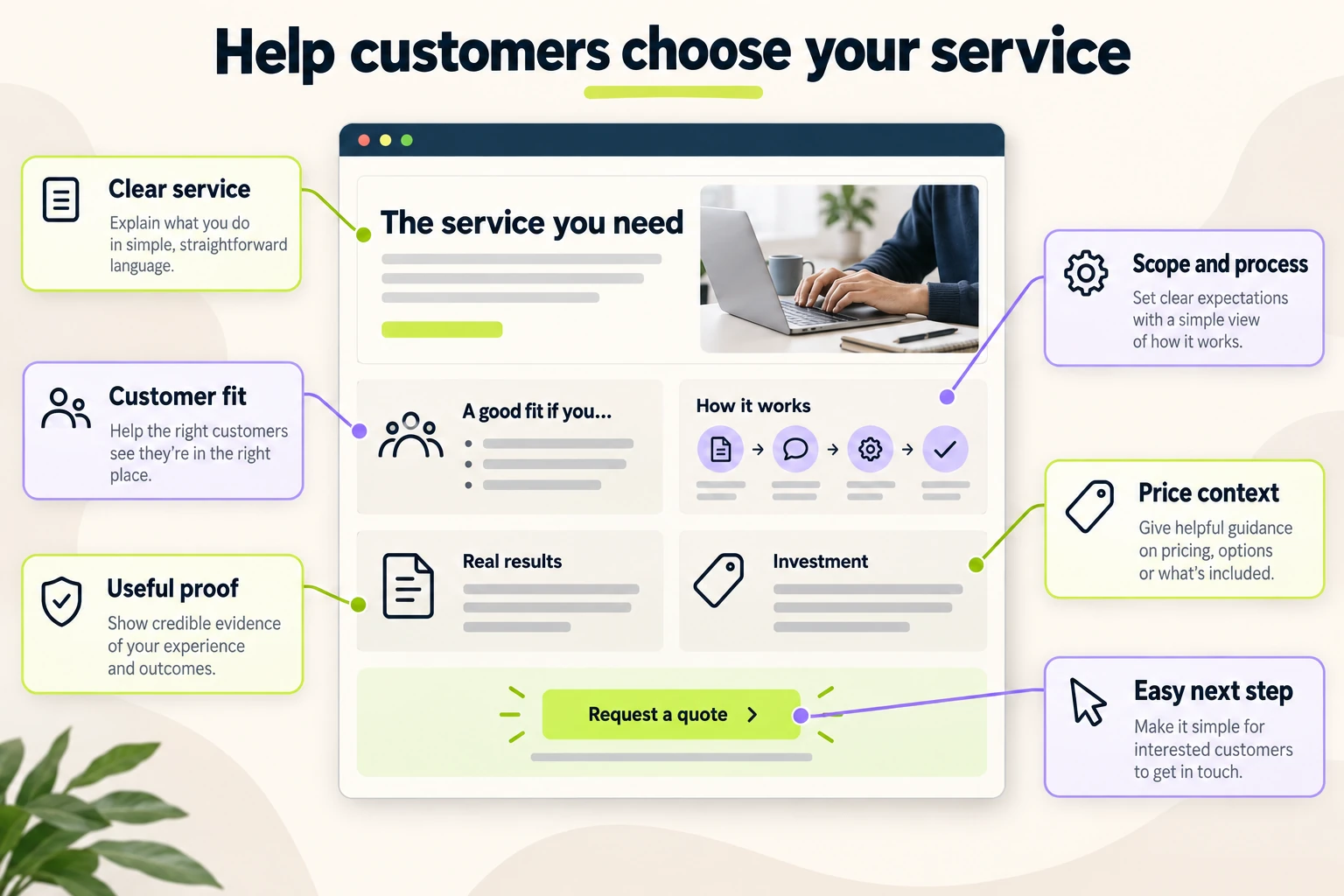
Make Your Service Page Clearer and Easier to Act On
Improve a service page for SEO and customer inquiries by making the offer easy to understand and act on. Name the service, explain who it is for, show what is included, answer the questions customers ask before contacting you, and provide relevant evidence. To optimize your service page, align the title, main heading and internal links with that offer, then test the complete inquiry path.
Potential customers may arrive from Google with a specific need. They want to know whether you handle their kind of work, serve their area, fit their requirements and offer a sensible next step. A page full of broad claims leaves those decisions unfinished.
This guide shows how to improve an existing service page, including a worked copy example and a review checklist. If you are still deciding which website problem deserves attention, start with what to fix first for search visibility.
Choose one service page and its target customer
A service page explains a specific service a business provides and helps a prospective customer evaluate it. A services overview can introduce several offers and link to the pages that explain each one. Your homepage usually has the broader job of introducing the business.
Choose an important service you actually want more suitable inquiries for. Write down the customer, their situation and the decision the page should support. “Office managers comparing scheduled cleaning providers” gives a writer a clearer task than “anyone who needs cleaning.”
Before creating a new URL, check whether an existing page already serves that need. Improve the appropriate page when its purpose is still right. Add a separate service page when the offer, customer questions or decision process needs a distinct explanation.
For example, a company offering office cleaning and industrial equipment cleaning may need separate pages because the scope, safety requirements and customer expectations differ. Two phrases describing the same office-cleaning offer may belong on one page. Review the searches and the business details before splitting the content.
Keep a useful existing URL unless there is a reason to change it. A URL change adds redirect and internal-link work; clearer copy often belongs at the current address.
Collect the facts before rewriting the service page content
Ask the people who deliver the work and handle inquiries what customers need to know. Sales questions reveal uncertainty; delivery teams can confirm the scope and practical limits. Bring those answers into the brief before asking a writer to fill the page.
| Page information | What to confirm | Useful source |
|---|---|---|
| Service scope | Included work, optional extras and exclusions | Service owner and current scope documents |
| Customer fit | Suitable customers, locations and project requirements | Recent inquiry patterns and delivery team |
| Process | What happens from first contact to completion | The team responsible for each stage |
| Price and timing | Confirmed prices or the factors that determine a quote and schedule | Approved pricing and booking process |
| Evidence | Relevant work, credentials, photographs and approved customer feedback | Verified records and permission to publish |
| Next action | What visitors can request and what information is needed | The person receiving and responding to inquiries |
Keep uncertain details out of the draft until someone can confirm them. A writer should not infer a warranty, qualification, response time or service area from what another company offers. Use the content brief template to record the page’s purpose, required answers, evidence and owner.
Service page SEO best practices: titles, headings and links
Service page SEO is search engine optimization applied to a specific offer. It brings together clear content, page structure, technical access and the user experience customers receive. Start with a useful page about a real service. Google’s helpful-content guidance encourages original, reliable information that helps the intended audience accomplish its task.
Match keyword research to the customer’s search intent
Use the words customers use in calls and inquiries, then check relevant search queries and search results. Notice whether a searcher wants a provider, a price explanation, instructions or a comparison. A service page should help someone evaluate the provider’s offer; a detailed advice article may answer a different need.
A search such as “office cleaning company San Diego” suggests a different task from “how to clean an office chair.” Choose a primary service topic that fits your target customer. Use meaningful variations where they make the explanation natural and precise.
Use search volume as context alongside the customer’s task and the work you sell. Review the live results to see what types of pages answer that search. A lower-volume service query can still be worth covering when it describes work the business wants and can deliver.
When the page already receives search traffic, review its relevant queries in Google Search Console. Ask whether the page answers those searches accurately. An unrelated query does not automatically deserve a new section. Your keyword research should help clarify the offer and the customer need.
Align the title tag, main heading and opening
Write a title tag that identifies the service clearly. Add a location when it accurately defines the offer and helps the customer choose. A page about scheduled office cleaning in San Diego could use “Office Cleaning in San Diego | Company Name.”
Give the page a descriptive main heading and an opening that develops the same promise. Explain the service, customer fit and useful next action early. Google’s title-link guidance describes how page titles, headings and other sources can influence the title shown in search results.
Write a page-specific meta description summarizing what a visitor can learn or request. Google may generate the displayed snippet from the page content, as its snippet documentation explains. Make the actual page as clear as its metadata.
Use headings that help a visitor compare and decide
Organize the content around useful questions: what is included, who the service suits, how the process works, what affects the price and how to begin. Keep paragraphs short enough to scan, and use a list or table when it makes several options easier to compare.
Headings such as “What our office-cleaning service includes” or “How your cleaning quote is prepared” help a visitor locate an answer. Repeating the same keyword in every heading can make the page awkward without adding information.
Connect the service page with useful internal links
Link to the page from the relevant services overview, navigation and supporting articles. Within the service page, link to details that help the reader continue, such as a project example, related service or booking process. Use descriptive link text and check the destination.
A cost guide, project example or comparison article can answer a deeper question and link to the service page. This connects content marketing with the next customer decision. Give individual pages on your site a clear purpose so readers can move from research to the appropriate offer.
Google’s link guidance explains crawlable links and useful anchor text. For a public service page you want in search, also check that it loads successfully and that its indexing and canonical settings reflect the intended URL. A technical SEO check can investigate access problems that copy edits cannot resolve. Fix those before judging the rewrite’s search performance.
Answer the questions that shape a customer inquiry
A strong service page gives customers enough information to recognize whether the business could meet their need. Work through the questions below using the facts collected in the brief.
What does the service include?
Describe the work in terms a customer can understand. Separate the standard scope from optional work, and explain important exclusions. A list of services should make the offer more specific than a claim such as “solutions tailored to your needs.”
Where a service varies by project, explain how the scope is agreed. A cleaning provider might review the premises and confirm the tasks and frequency in a written plan. A consultant might start with a defined assessment before proposing ongoing work. Use the process your business actually follows.
How does the work begin, and what affects price?
Explain the steps from first contact to an agreed scope and delivery. Tell the reader whether the next action is a booking, estimate request, site visit or initial conversation. Describe any assessment fee or commitment that applies before they take that step.
Publish accurate prices or packages when they are meaningful and approved. For work priced individually, explain the main cost factors and how a quote is prepared. A customer can still learn whether the service fits when you explain how scope, frequency, access or specialist requirements affect the price.
Avoid unsupported “starting from” prices or precise completion times that the delivery team cannot honor. Useful pricing context should make the next conversation clearer.
What evidence helps someone trust the offer?
Choose evidence relevant to the service: a documented project, approved photographs, a specific customer review, verified credentials or an explanation of who performs the work. Describe what each item demonstrates.
A photograph with a useful caption can explain the work more clearly than a generic stock image. Confirm permission to publish, remove private customer information and provide appropriate alternative text. A testimonial about a different service needs enough context for a reader to interpret it fairly.
Replace broad claims such as “the best team in the industry” with something a visitor can evaluate. Credentials should be current, project descriptions should reflect the actual work, and customer quotations should preserve their meaning.
Which questions belong in a service-page FAQ?
Use real recurring questions about scope, preparation, price, scheduling, responsibilities and the next step. Put information essential to the decision in the main content, where it is easy to find. An FAQ can address the remaining questions that apply to particular situations.
For an office-cleaning page, a visitor might ask whether cleaning can take place outside office hours or whether specialist floor work is included. Answer from confirmed operating arrangements. Each answer should resolve a useful question rather than repeat the service name.
Local SEO: service pages, location pages and service areas
State the customer types or projects you can support and the real location or service area. Mention practical requirements that materially affect fit, such as access arrangements, property type, project size or required lead time.
For a local business, check that this information agrees with the services and locations described on its Google Business Profile. Review the profile’s website destination too. Local SEO includes the business profile and other local signals, so keep the service page connected to the information customers see elsewhere.
Compare the service page and any location pages side by side. Keep the core service explanation consistent, and give each location page useful local information about availability, customer fit and relevant work. One service page can explain several areas when the offer and customer decision are the same across them.
Service area pages can explain meaningful differences in access or the work performed in a location. Repeating the same service copy across many city pages gives customers little additional guidance and creates more pages to maintain. Use the local SEO checklist for the wider local search review.
Improve service page design and the inquiry path
Website design should help customers make a decision. Give the service explanation, useful proof and next action a clear place in the reading sequence. Review the layout with the same questions you use for the copy: can a visitor recognize the offer, evaluate it and continue?
Make the call to action specific
Choose a primary call to action that describes what the visitor is requesting. “Request an office-cleaning quote” sets a clearer expectation than “Submit.” Place the action near the opening and again where a reader has enough information to proceed.
Keep the form focused on the information needed for the next conversation. A service inquiry may need contact details, location and a short description of the work. Add more fields when they are necessary to assess fit, and explain unfamiliar requests. Review whether optional details could be collected during follow-up.
Check mobile usability and the complete inquiry path
Check the page on a phone. The service information, form labels and contact actions should remain readable and usable. Look for banners covering controls, images shifting the layout or third-party widgets delaying the page. Google’s page-experience guidance covers the wider experience visitors receive.
Test the complete inquiry path through your normal QA process. Confirm that a form submission reaches the right person and displays an appropriate confirmation. Check phone and booking destinations too. Only promise a response time on the page if the team has approved and can support it.
Worked example: improving an office-cleaning service page
This copy example uses a hypothetical office-cleaning business serving the city of San Diego. Its assumed service includes scheduled cleaning of work areas, restrooms and shared spaces, with the scope and price agreed after reviewing the premises.
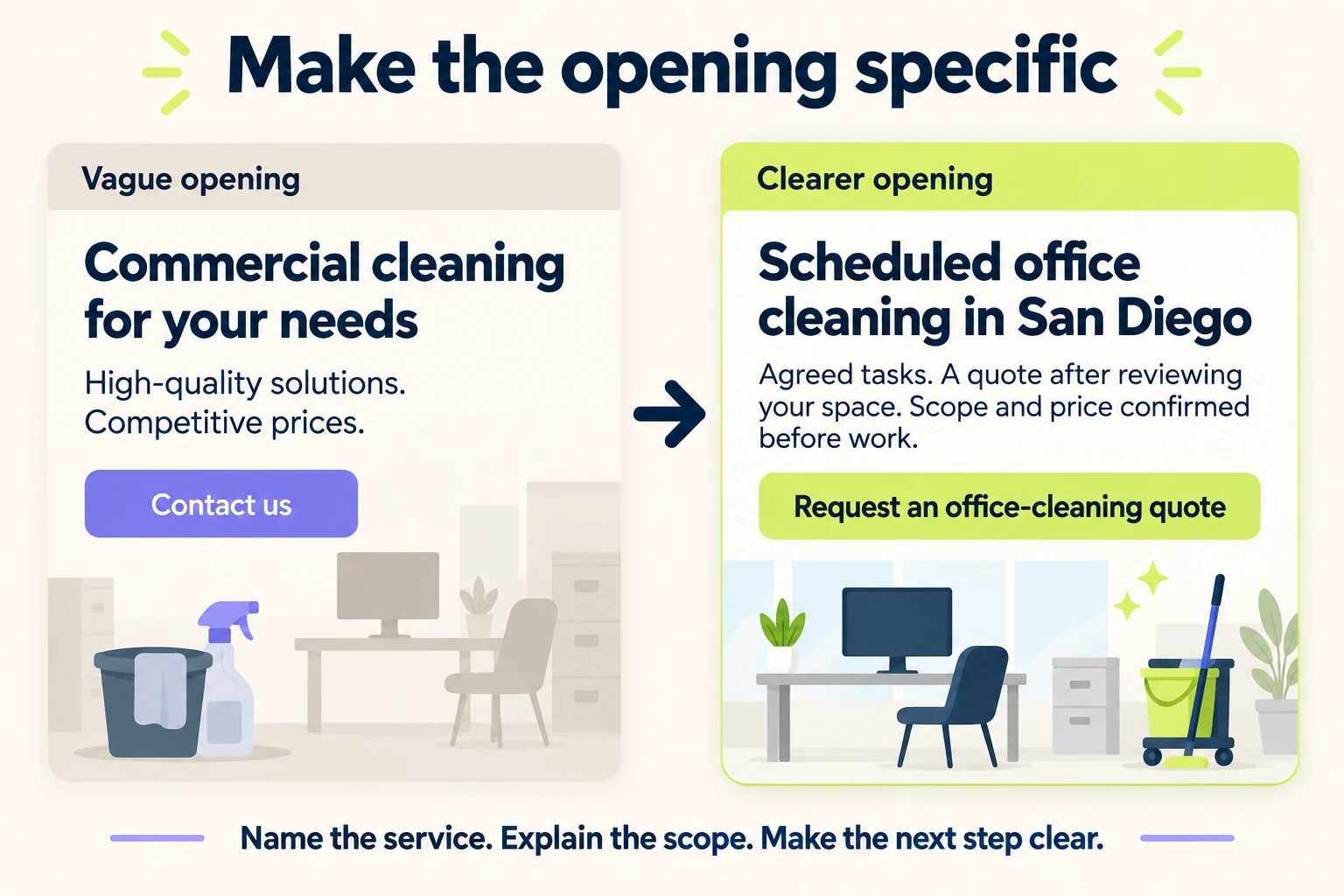
A vague opening
We provide high-quality commercial cleaning tailored to your needs. Our professional team delivers exceptional service at competitive prices. Contact us today.
A visitor still has to ask what the service includes, where it is available and what contacting the company will lead to. The wording gives the business few useful facts to support.
A more useful opening and next step
Scheduled Office Cleaning in San Diego
Keep your office ready for the next workday with a cleaning plan based on how your space is used. We provide scheduled cleaning for offices in the city of San Diego, covering the agreed tasks in work areas, restrooms and shared spaces.
Your quote is prepared after we review the premises, required tasks and preferred cleaning frequency. We confirm the scope and price before you agree to start.
Request an office-cleaning quote
Tell us your location, approximate office size and preferred schedule so we can review the work you need.
The revised copy uses the assumed facts to make the offer and next action specific. A real business would adapt it to its confirmed service. It would also add relevant project evidence, operating details and answers to its customers’ questions.
| Customer question | Answer in the revised copy |
|---|---|
| Is this the service I need? | Scheduled office cleaning with an agreed task list |
| Does the company serve my area? | The city of San Diego is named |
| How will I learn the price? | The company reviews the premises, tasks and frequency before preparing a quote |
| What should I request? | An office-cleaning quote, with the basic details needed to review it |
Use the same questions to review your own opening. Identify the details a visitor still has to request, then check whether the business can supply them on the page.
Audit the page with this service page SEO checklist
A practical page audit combines copy review with technical and contact-path checks. Ask someone unfamiliar with the business to explain the offer back to you. Note where they hesitate, misunderstand the scope or need information that the page omits. Combine that feedback with the checks below.
- Offer: The title, main heading and opening describe the same specific service.
- Fit: The customer, service area, scope and important requirements are clear.
- Decision details: The process, pricing context and recurring questions have useful answers.
- Evidence: Claims, credentials, photographs and customer feedback are accurate and approved.
- Navigation: Relevant pages link to the service, and its own links reach the intended destinations.
- Experience: The page is readable on a phone and usable with a keyboard, with clear labels and image alternatives.
- Inquiry: The form, phone or booking path works through to its destination.
- Search settings: The public page loads, its intended URL is clear, and indexing restrictions have been reviewed.
Record the changes and publication date. Assign someone to maintain the page when the offer, prices, service area or operating arrangements change.
Review search rankings and suitable inquiries after the update
Save a baseline for the page before changing it. Where data is available, note relevant Google Search queries, impressions and clicks, organic landing-page visits, completed inquiries and which inquiries fit the service. Keep the reporting period and filters consistent.
Verify functional corrections as soon as the update is released. Review search performance after Google has processed the change and enough comparable data has accumulated. Record other SEO efforts, seasonal demand and the mix of queries when interpreting a result. If the page also receives paid or referral traffic, separate those sources when reviewing its digital marketing results.
Ask the receiving team whether inquiries include the information needed to respond and whether recurring misunderstandings have changed. Use the guide to measuring SEO leads for the tracking and qualification process. A form submission is one step; customer fit and the later sales outcome need their own records.
Frequently asked questions about service page SEO
Why are service pages important for SEO?
A dedicated page gives a specific service room for its own explanation, customer questions and evidence. That helps search engines understand the offer and gives a visitor a useful destination for a relevant search. Rankings depend on more than the existence of a page; its relevance, accessibility and the wider website still need review.
Why is my service page not ranking?
Check that the intended URL can be indexed, then compare the page with the customer’s search intent and the results that currently appear. An indexed page with weak rankings may need clearer service details, relevant evidence or better internal links. Review the actual queries and locations before choosing a correction. A content score alone cannot diagnose the cause.
How long should a service page be?
Give the customer enough detail to evaluate the offer and take the next step. A simple appointment service may need less explanation than a complex project. Google’s helpful-content guidance does not prescribe a preferred word count. Use the scope, questions and evidence to decide what belongs.
Should every keyword have its own service page?
Several phrases can describe the same service and customer need. Cover those naturally on the appropriate page. Create separate pages when the services or customer decisions need distinct explanations, and make their relationship clear through navigation and internal links.
What is the difference between a service page and a landing page?
A service page describes a business’s offer. A landing page is the page a visitor arrives on, and the term can also describe a page built for a specific campaign. A service page can be an organic-search landing page. Give each page a clear job and match its content and contact action to the visitor’s situation.
Can I improve the page if I cannot publish fixed prices?
Explain how a quote is prepared, which factors affect cost and whether an assessment has a fee. Include any approved minimums or requirements that help customers judge fit. Confirm the details with the person responsible for pricing before publishing them.
Turn the review into one clear service-page brief
Choose an important service page and identify its unanswered customer questions. Collect the business facts and evidence, rewrite the relevant sections, then verify the search settings and inquiry path. Keep a record so the next review has a useful starting point.
If you need help with the structure, copy and internal links, TeamSoda’s on-page SEO service can help turn the findings into a focused page-improvement plan. Bring the page, the service you want to grow and the questions your customers already ask.