



How much should a small business pay for SEO each month?
Backlinko’s survey of more than 300 SEO professionals puts monthly SEO costs at USD 1,000–2,500 overall. Use that as a budgeting reference. A small business still needs a quote for its own site, market and implementation work.
Use the range to compare costs, then give two providers the same job. For example, ask them to repair the service-page inquiry path, revise the copy and test the form. The right SEO plan tells you which jobs the fee pays for and what your own developer must do.
How do SEO pricing models change what you pay for?
The three common SEO pricing models are monthly retainers, hourly consulting and fixed projects. The pricing model you choose changes who carries the risk if the job takes longer. Ask what can be completed, and what requires a new estimate.
| Pricing model | Published reference | When it can fit |
|---|---|---|
| Monthly SEO retainer | Backlinko reports USD 1,000–USD 2,500 overall; its higher tier is USD 2,501–USD 5,000 monthly | Ongoing priorities, implementation and review |
| Hourly SEO consulting | Backlinko reports USD 50–USD 100 per hour overall, with higher tiers for experienced specialists | A defined question, specialist review or guidance your team can implement |
| Project-based SEO | Backlinko reports a common USD 1,000–USD 5,000 project range, with larger projects above it | A bounded audit, migration review or set of agreed improvements |
Backlinko’s pricing guide, updated December 29, 2025, draws on a survey of more than 300 SEO professionals across regions and experience levels. These are broad provider survey figures, not a small-business invoice average or a guarantee of what any package includes.
For another perspective, Ahrefs’ study of 439 SEO service providers reports different rates by geography, experience and provider type. The linked article was updated August 15, 2024; that is its publication update date, not a confirmed survey collection date. Use the study to understand why quotes vary, rather than presenting its figures as newly collected 2026 prices.
When does monthly SEO make sense?
A monthly program can fit a business with several connected needs: improving service pages, resolving website issues, developing useful content and checking which inquiries become suitable customers. Ask what will be implemented during the first review period and how later priorities are chosen.
A retainer should make the working relationship clear. Confirm the review rhythm, available production capacity, approval process and how the agency reports completed changes. A report-only subscription and a managed SEO campaign are different purchases, even when both arrive as a monthly invoice.
When is a project or hourly engagement enough?
A project can work when the problem and finish line are clear. For example, a professional-services firm may need a specific set of service pages improved while its own team handles regular publishing. An hourly consultant can review a technical decision or help an internal marketer prioritize a backlog.
An SEO audit usually buys diagnosis and recommendations. Ask whether fixing the findings, checking the changes and measuring the result are included. A useful audit can be the right first purchase when its recommendations have an implementation owner.
What Drives the Cost of SEO for a Small Business?
Two companies with similar revenue can need very different SEO strategies. A quote should connect its price to the work your situation requires. Ask the provider to explain the main cost drivers using your website and market.
Your website’s starting condition
A site with clear services, usable pages and reliable tracking presents a different starting point from one with inaccessible pages, confusing navigation or an unfinished migration. Technical SEO can involve diagnosis, developer requirements, release coordination and checks after changes go live. Confirm which of those steps the quote covers.
If the important tools and page structure already work, a rebuild may be unnecessary. Our guide to SEO repairs versus website redesign explains how to separate those decisions.
The markets, services and competitors involved
A local repair business serving one area has a different search footprint from an accountancy firm targeting several cities or an ecommerce store with a large catalog. More markets, products and customer questions can increase research, content, coordination and quality checks. Competitive search results may also require stronger expertise and supporting evidence. Choosing a scope based on business size alone can overlook those differences.
Local SEO should connect the business profile, relevant pages and inquiry path. National SEO and ecommerce SEO may involve broader page coverage or more complex website templates. The provider should explain which work is relevant rather than charging for every possible tactic.
Who researches, writes, implements and approves
One SEO company may supply recommendations while another also writes, edits, publishes and validates the changes. An experienced internal marketing team can take on some responsibilities. A business without that capacity needs the proposal to account for execution.
Subject expertise matters too. Your team may need to confirm service details, review claims or provide product knowledge. Budget for that time even when a provider handles the writing. Agree on responsibilities before using a price comparison to choose an agency.
DIY SEO, In-House SEO or an Agency?
For small business owners, deciding whether to hire an SEO specialist starts with available time, skills and responsibility. Professional SEO services can provide expertise and delivery capacity, but your business still needs someone to supply accurate information and approve the work.
DIY SEO: keep the first tasks manageable
A business owner can do useful work directly: update service information, answer common customer questions and check the contact process. For a local business, Google Business Profile optimization can sit alongside accurate service pages and a usable website. Our local SEO checklist helps organize those checks. Include your own time and any software costs when comparing this route with paid support.
In-house support: give the work a real owner
An internal marketer needs time, access and a route to developers or subject experts. If that capacity exists, an experienced SEO consultant can provide specialist review while your team implements the changes. If it does not, a growing recommendation list can remain unfinished. An SEO team should have an agreed way to research, approve, publish and check the work, whether its members are internal or external.
Agency support: coordinate the skills you need
SEO agencies can bring several skills into one program when your SEO needs span research, content, technical changes and measurement. Ask which specialists are involved and what they deliver. A comprehensive SEO scope should connect those responsibilities to your business goals. Selecting an SEO provider also means checking who communicates with your team and handles work outside the original agreement. Use the SEO agency evaluation guide to compare experience, staffing and communication.
How Should You Set a Small Business SEO Budget?
Start with one business priority, then map the SEO work needed to support it. Ask how the provider will report on rankings, Maps and leads so you can review the work against that priority. Your first SEO investment might improve a particular service’s discovery and inquiry path, rather than attempt every market at once. The size of your business is useful context, but the scope should follow the actual constraint.
- Define the customer and action. Identify the service or product, market and kind of inquiry or purchase you want to support.
- Check the starting point. Review website access, useful page coverage, local information where relevant and whether tracking works.
- Assign implementation. Establish which SEO services your provider will deliver and what your team can reasonably handle.
- Compare the full commitment. Add setup, recurring fees and separate expenses over the same planning period for each quote.
- Agree on a review point. Set delivery checks and useful outcome measures before deciding whether to expand the program.
Before you invest in SEO, compare your release calendar with the proposal. If local SEO services cover three branches but the developer can update only one per month, phase the work. Ongoing SEO requires someone with time to approve and publish each change.
What Should Be Included in Monthly SEO Services?
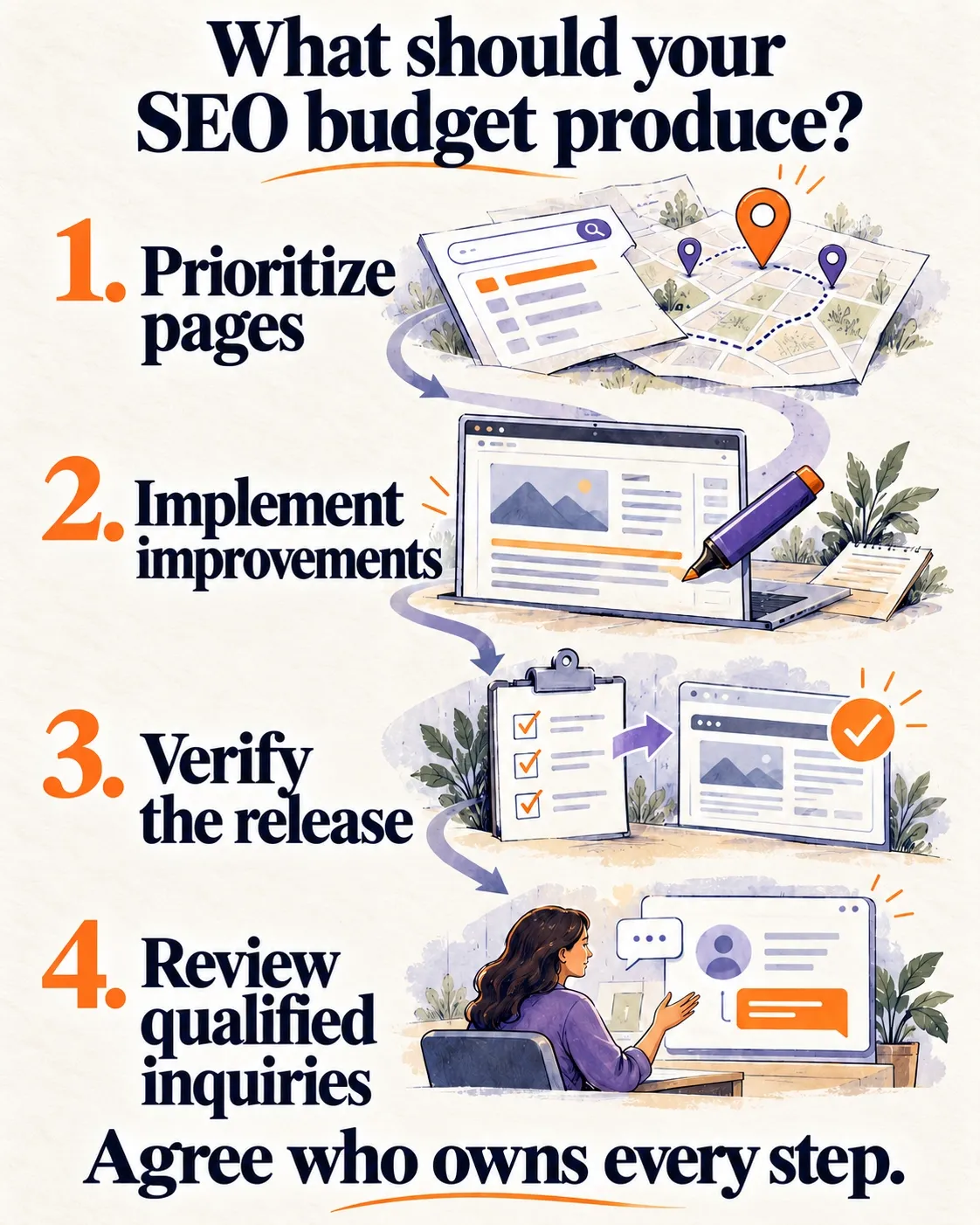
Mark who owns each item in the table. If a provider will diagnose a broken quote form but your developer must repair it, put both names and both costs in the budget.
| Area | Useful deliverable | Clarify before buying |
|---|---|---|
| Strategy and keyword research | Priority services, customer questions, target pages and a reason for the order of work | Who approves the priorities and revises them after feedback? |
| Technical SEO | Specific affected URLs, implementation requirements and checks after release | Does the provider make the changes or hand them to your developer? |
| On-page SEO | Improved page structure, titles, useful answers, internal links and inquiry paths | Which pages are included, and who publishes them? |
| Content development | Briefs, expert input, writing, editing and agreed revisions | Are new pages included, and who checks factual claims? |
| Local search | Relevant business-profile, service-area and website improvements | Which locations and profiles are covered? |
| Authority work | A relevant research, outreach or digital PR plan with transparent methods | Which expenses are separate, and how are paid placements identified? |
| Measurement | Completed work, search evidence, qualified inquiry checks and next decisions | Can you access the underlying accounts and reports? |
A deliverable needs enough detail to assess. “On-page optimization” becomes useful when it identifies the pages, intended changes, reviewer and acceptance checks. Our service-page guide shows what a page-level assignment can cover. A fixed number of articles or backlinks is less informative without their purpose, quality criteria and relationship to your services.
How Do You Compare SEO Packages Fairly?
Put each proposal against the same business brief: your priority services, locations, website, available team and definition of a qualified inquiry. Then compare responsibilities and outputs. The cheapest fee may leave work for your staff, while a more comprehensive scope may cover tasks you do not currently need.
| Scope | What you are buying | What your team still needs to do |
|---|---|---|
| Advisory support | Research, priorities, briefs and specialist review | Provide implementation, publishing and ongoing ownership |
| Focused implementation project | Defined changes to agreed pages or technical issues, with acceptance checks | Approve the work and maintain areas outside the project |
| Managed search program | Recurring research, production, implementation and review within an agreed scope | Supply business expertise, access, approvals and sales feedback |
For each quote, ask the provider to mark what is included, what is separate and what your team owns. Confirm page or location coverage, revision limits, specialist access and the process for urgent issues. Any proposed increase should identify additional work or a changed requirement.
For pricing, the essential question is whether the proposals cover comparable work.
Does cheap SEO always mean poor work?
A lower cost can be reasonable for a smaller scope. Ask the SEO experts bidding on the job to walk through one month: which changes will appear on your site, and which still need a separate budget? A reputable SEO provider should be able to price that difference.
Which Costs Can Sit Outside Your SEO Retainer?
Ask which of the following expenses sit outside the retainer and who must approve them.
- Implementation: developer time, template changes, design or website work outside the agency’s scope.
- Content production: expert interviews, photography, specialist review, extra pages or revisions beyond the agreement.
- Tools and tracking: software, call tracking or other third-party subscriptions, including who owns and pays for the accounts.
- Setup and project fees: initial research, an audit, tracking configuration or a specific repair.
- Authority and distribution: research production, outreach support or disclosed placement expenses.
- Your team’s time: meetings, approvals, access, factual review and lead-quality feedback.
Advertising spend is a separate budget from organic SEO unless the agreement explicitly combines them. Hosting, a full website rebuild and sales operations should also have a clear owner and price where needed. Check whether an apparent saving on the retainer creates another cost elsewhere.
Authority work deserves a direct explanation. Ask how opportunities are selected, what you pay for and whether links are editorial or paid. Google’s outbound-link guidance calls for qualifying paid links with sponsored; a proposal should describe its methods and disclosures clearly.
Do AI SEO, AEO and GEO Change the Price?
They can change the scope, but the labels alone do not explain an additional fee. Ask which customer questions, platforms, content improvements, business-fact checks and measurement tasks are included. Map shared work once and identify any additional research or production separately.
Google says its established SEO practices still apply to AI Overviews and AI Mode. Ask the provider to name the platform and explain which extra work the quote covers, since the scope may differ across platforms.
An agency may still do useful work on clearer service information, expert evidence, consistent business facts and the sources customers encounter. A proposal for AI SEO, answer engine optimization or generative engine optimization should make those activities reviewable. It should also distinguish being mentioned, being cited and receiving a qualified inquiry.
TeamSoda’s AI SEO services connect that work with the wider website and search program. Practical AI marketing workflows are a separate need: producing content or reports more efficiently does not automatically create search visibility.
What Are TeamSoda’s Published SEO Starting Prices?
TeamSoda lists the following managed-plan starting prices as of November 23, 2026. The final quote depends on the site, market and work agreed.
| Plan | Published starting price | Published focus |
|---|---|---|
| SODA Local | USD 499 per month | A focused local or service-area program: roadmap, profile guidance, priority page improvements, technical and lead-tracking review |
| SODA Growth | USD 2,500 per month | Several search priorities: SEO and AI-search roadmap, technical and on-page implementation, content, authority planning and qualified-lead measurement |
| SODA Scale | USD 4,500 per month | Complex sites or markets: search architecture, technical governance, editorial coordination, AI visibility and reporting |
Review the current SODA plans and included scope before choosing. The published starting price is the minimum for that plan; the exact investment is tailored before checkout. Confirm implementation responsibilities, capacity and exclusions for your business.
A bounded task may suit a separate project. TeamSoda currently lists an SEO Audit from USD 1,250 one-time, a Technical SEO Sprint from USD 1,500 one-time, On-Page Optimization from USD 350 per page and an SEO Content Page from USD 650 per page. These are separate starting offers with different units. Check the individual-service scope and agreed quantities; they are not automatic extras on every managed plan.
How Do You Decide Whether SEO Is Worth the Cost?
Start with the customer action that matters: a suitable consultation, booked appointment, qualified call or completed purchase. Track the search and page evidence leading toward that action, then connect it with sales feedback where possible. Traffic and keyword rankings can help explain progress, but they do not establish profit by themselves.
A useful planning calculation is:
Break-even additional customers = full program cost ÷ contribution per additional customer.
Suppose your total monthly program cost is USD 2,500 and each additional customer contributes USD 500 after the relevant costs of serving that customer. The arithmetic gives five additional customers for break-even. Those are stated planning assumptions, not a forecast or a TeamSoda client result. Use your own margins, costs and sales timing, and assess actual contribution over the appropriate period.

Agree on checkpoints for both delivery and outcomes. Early reviews can confirm that priority changes shipped, tracking works and the right pages are eligible for search. Later reviews can examine relevant search appearances, inquiry quality and won work. Choose the timing around the website, sales cycle and work involved; a calendar deadline cannot guarantee a ranking or return.
Our guide to measuring SEO calls, forms and leads explains how to connect those observations. Ask providers to separate measured results, estimates and their interpretation of what caused a change.
What Should You Ask Before Signing an SEO Contract?
- Which business problem, services and pages will you prioritize first?
- What will you implement directly, and what must our team supply or change?
- What does the monthly fee include, and which setup, production or third-party costs are separate?
- Who reviews content and technical changes, and how are revisions handled?
- Which accounts, content and completed work will we own and retain?
- What will the reports show, and how will qualified inquiries be checked?
- What are the commitment, notice and handover terms if we stop?
Google’s advice on hiring an SEO recommends asking about previous work, methods, communication and measurement. It also warns that nobody can guarantee a number-one ranking. Price should be assessed alongside the provider’s proposed work, relevant experience and willingness to explain its decisions.
Choose the First Scope Your Business Can Support
Before approving the retainer, ask the person doing the work to walk through the first change from finding to release. If a developer is needed, put that cost and their availability beside the agency fee. That is the budget you need to approve.
To price a scope around your own site, request a TeamSoda visibility review. Include the service you want to grow, the customer action that is failing and who can release a fix.