



Which Service Areas Deserve Their Own Website Page?
A homeowner in the next town wants to know whether your crew will travel there and what it can do on that visit. Before creating a service area page, write down the answers your dispatcher can confirm. If the only new detail is the town name, a coverage section on the existing service page may be enough.
A dispatcher can confirm where a mobile crew travels and whether a trip fee applies. A branch manager can confirm the address and hours where customers can visit. Decide which promise you are making before you put a town name in the heading.
What Is a Service Area Page, and How Is It Different From a Location Page?
A service area page explains how a business provides services in a particular geographic area. It can be useful even when the business has no public office there. A location page describes a real physical location, such as a store, clinic or staffed branch. A service page explains the offer itself: what is included, who it suits and how the work happens.
These pages can support each other. They should not leave customers guessing which one contains the information they need.
| Page | Main customer question | Useful information |
|---|---|---|
| Service page | Is this the right service for my problem? | Scope, process, suitability, conditions and proof |
| Service-area page | Can you provide this service where I need it? | Actual coverage, local availability, relevant work and inquiry route |
| Location page | Which branch should I visit or contact? | Real address, opening hours, access, local team and branch-specific services |
| Coverage hub | Which areas do you serve? | Clear regional coverage and links to useful dedicated pages |
Do not imply an office exists merely because you want to appear in a city’s search results. Your website and Google Business Profile should represent the business truthfully. Google’s business representation guidelines explain service-area and location eligibility. A website landing page does not establish eligibility for another profile.
How Do You Choose Service Areas for Local SEO?
Begin with the operating territory, not a keyword export. Ask which places the team can reliably serve, which services are available there, how travel affects the engagement and whether you want more of those customers. Search visibility is useful only when the business can support the inquiry.
Then investigate the opportunity. Review existing inquiries, customer addresses at an appropriate aggregate level, search-query data and keyword estimates. Check the actual search results for the service and place. Do they show nearby branches, service businesses, specialist directories or informational guides? A national volume estimate cannot establish demand in one small town.
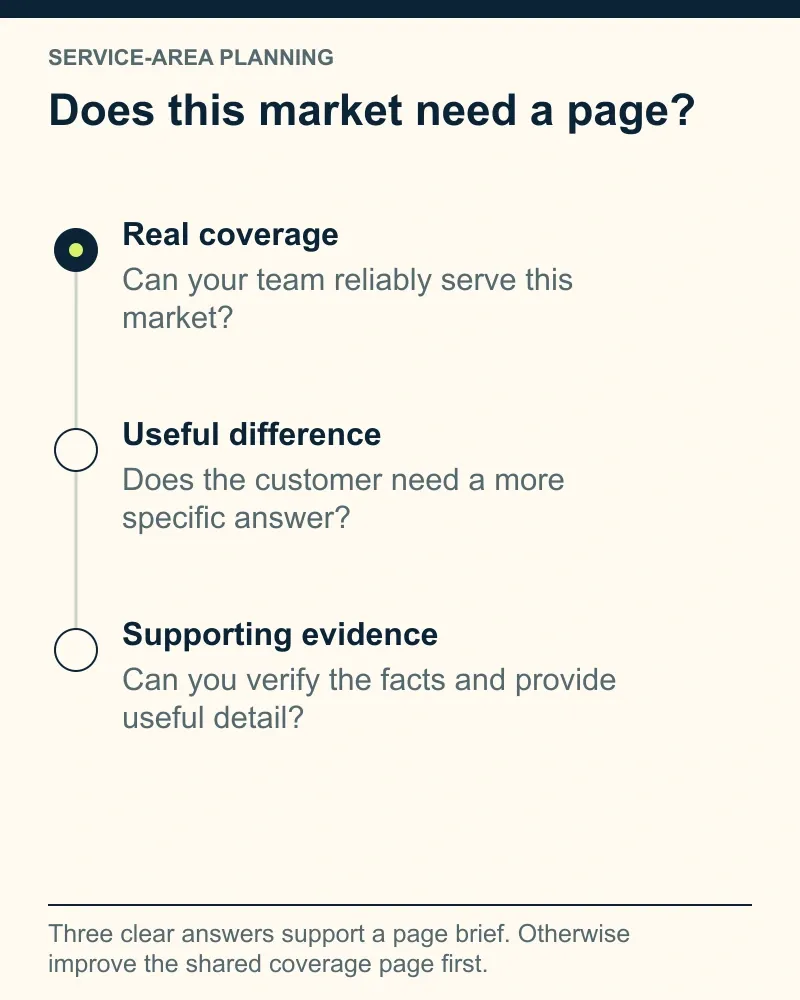
Use three practical questions before commissioning a new page:
- Commercial fit: Would you welcome a suitable inquiry from this market, with its travel and delivery conditions?
- Customer need: Does this place introduce an availability, service, access or buying question that deserves a clearer answer?
- Evidence: Can your team verify the coverage and supply something useful beyond a different city name?
If the answers are weak, improve the coverage hub or existing service page first. You do not need a page for every city on a map. A smaller set of well-supported pages is easier to review, maintain and route to the right team.
How many service area pages should you create?
There is no useful universal count. Start with the markets for which you can produce a complete brief. One regional page may serve several nearby communities well. Separate pages become more useful when the service offer, customer task or supporting evidence materially differs.
For a first release, choose a manageable group and review it before expanding. Publishing more pages creates more maintenance work: availability changes, service boundaries move and older examples need checking. Include that work in the SEO strategy and budget. Use the local SEO checklist to review the business information and contact paths that support those pages.
What Should a Strong Service Area Page Include?
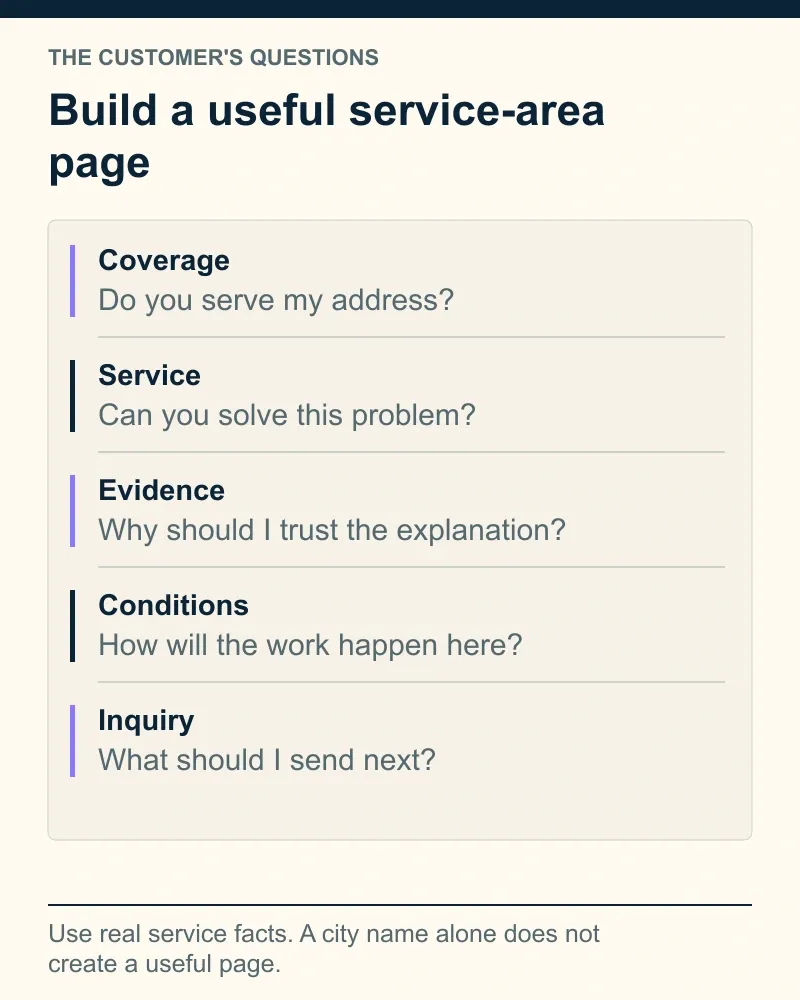
A useful service-area page should let someone establish fit without returning to a search engine to answer basic questions. Write for the customer who has a real need in that market. Use the service-page SEO guide to plan the main service explanation before adapting it for a real market.
- A direct opening: say what you provide, where and for whom. Avoid broad claims about being the best local business.
- Actual service boundaries: explain relevant exclusions, travel arrangements or address checks. Do not promise a response time the operating team cannot confirm.
- The relevant offer: show which services are available locally and link to fuller service pages when helpful.
- Useful evidence: include permission-cleared work examples, relevant experience, original process details or a customer question your team regularly answers.
- Decision information: explain how estimates, site visits, delivery, appointments or onboarding work in that area.
- A clear inquiry path: show the appropriate call, booking or form action and what information the customer should provide.
Use descriptive titles and headings. A title such as “Commercial Cleaning in [City]: Coverage and Service Options” tells the reader what the page does. The bracketed place is a planning placeholder, not copy to publish. Use the real service and market only after your team confirms them.
Do not pad a landing page with local history, landmarks or a list of ZIP codes unless those details help the buyer understand delivery. Geographic trivia is not a substitute for local knowledge about the service.
How Can You Make Service Area Pages Unique Without Inventing Local Proof?
Ask the people who deliver the work what changes between markets. A cleaning company may have different access arrangements for office buildings. An equipment-repair company may offer scheduled route visits in one area and on-demand visits in another. A photographer may need to explain travel and venue coordination. Those differences help customers qualify themselves.
Use facts you can substantiate. If there is no completed project in a market, do not manufacture one. Explain the real process and scope, use broader relevant experience honestly, and decide whether the location belongs on a regional page until more evidence is available.
Two page briefs with different decisions
Consider a pool-maintenance company planning coverage pages. One established service area has a regular route, confirmed property types and permission to describe completed equipment replacements. Its page can explain scheduling, service boundaries and those projects. Another town is only an expansion possibility with no confirmed route. That market needs an operating decision before it needs a published promise.
For a business-to-business training provider, the difference may be delivery format rather than distance. An area page can explain on-site availability, minimum group arrangements and booking lead time if these are real conditions. It should not pretend to have a classroom in every city.
Are similar pages automatically doorway pages?
Shared design and accurate repeated service facts are normal. The concern is whether separate pages offer a useful destination or mainly exist to capture similar searches. Google’s doorway-abuse policy describes patterns involving substantially similar pages and intermediate destinations. Review usefulness and intent rather than chasing an arbitrary uniqueness percentage.
Ask a simple editing question: if the city name disappeared, would a reader still understand why this page exists separately? If the answer is no, the brief probably needs more work or consolidation.
What Structure and Technical SEO Best Practices Support Service Area Pages?
Make the structure understandable to people first. A coverage hub can link to regional or city pages. Each geographic page should link to the relevant service detail and contact route. Service pages can point readers toward genuine coverage information. This creates a browsable hierarchy instead of an isolated collection of search landing pages.
Choose the simplest structure the website can maintain. For example, an areas hub can lead to a regional page and then to selected city pages where those extra pages earn their place. A small site may only need the hub and a few dedicated pages. URL organization supports the editorial system; a keyword-heavy path does not compensate for weak page content.
Use descriptive internal links in context. Avoid attaching an enormous list of cities to every page footer. Repetition can make navigation harder and does little to explain which page serves which customer task.
Technical SEO checks should confirm that approved pages load correctly, are reachable through ordinary links and have appropriate indexability and canonical settings. Review mobile readability, image alternatives and the inquiry action too. A sitemap can support discovery, but it does not guarantee indexing or ranking.
These links help search engines discover the relationship between the main service and its coverage area. They also help a customer reach the service they need without moving across multiple pages that repeat the same promise. One page can explain several closely related communities when the delivery conditions are the same.
What should your page brief record before writing starts?
For each local landing page, record its primary customer task, confirmed coverage, relevant service, existing page owner and missing evidence. Name the person who will verify availability. Add the intended internal links and the inquiry destination so the writer is not left to invent a journey after drafting.
Collect page examples from your own website and mark which parts are reusable service facts and which require local input. Creating city pages becomes risky when a template asks writers to make every page unique without supplying anything distinct to say. Strong service area pages begin with a strong brief.
For an existing collection, inventory the pages on your site before adding more. Group URLs by service and market, flag overlapping customer tasks and check which valuable pages already receive useful inquiries. A service area page strategy can include improving, merging or holding pages as well as publishing new ones.
How Do You Measure Service Area Page SEO and Lead Quality?
Record the page, service and market before publication. Then review indexing in Google Search Console, relevant impressions and clicks alongside completed customer actions. Compare appropriate periods and note changes to staffing, coverage, advertising and tracking. Local SEO strategies should be judged against the actual markets and services the business wants to grow. Our approach to reporting by service and market shows how to compare the areas and jobs you want to grow.
For inquiries, distinguish a form submission from a qualified opportunity. Did the customer need an available service, in an area you actually cover, on workable terms? A page that attracts many out-of-area or unsuitable requests may need clearer boundaries even if visits rise. Use the lead measurement guide to distinguish submitted forms from inquiries your business can serve.
| What you observe | What to investigate |
|---|---|
| Page not indexed | Access, settings, internal discovery, duplication and actual page value |
| Impressions for the wrong service or market | Page purpose, headings, links and ambiguous coverage language |
| Relevant visits but few inquiries | Service fit, proof, contact friction and tracking reliability |
| Inquiries mostly outside scope | Coverage boundaries, exclusions and form questions |
| Several pages answer the same task | Whether clearer ownership or consolidation would help |
Do not delete a low-traffic page solely because a report is quiet. Check its role, age, demand, inquiry quality and links first. When consolidating genuinely overlapping pages, map the destination and update internal links with the technical team.
When Should You Get Help With Service Area Pages?
If several existing town pages compete for the same job, ask for a map showing which page to keep for each service and who can confirm the coverage. That gives you a brief you can price.
For help with that map, compare the scope of TeamSoda’s local SEO services with the work your dispatcher and editor can do internally.
Ask dispatch to read the proposed page before it goes live. A visitor should be able to tell whether you serve their address and how to confirm coverage at the edge of the route.